10GHz PA Using a Mini-Circuits PMA5-123 3W MMIC – Part 2

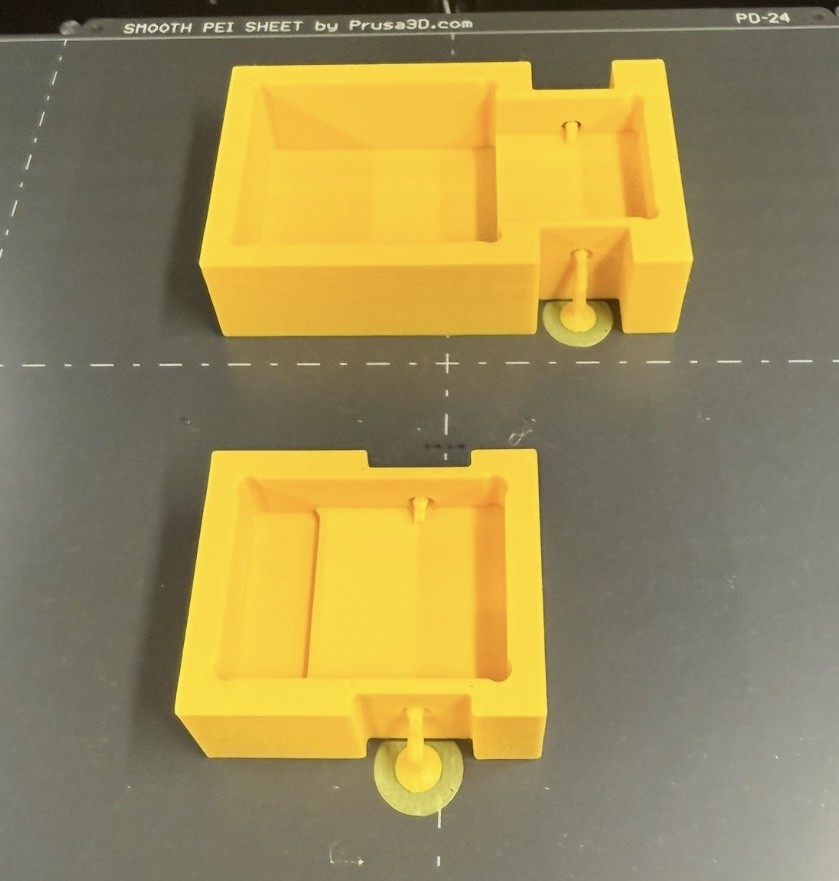
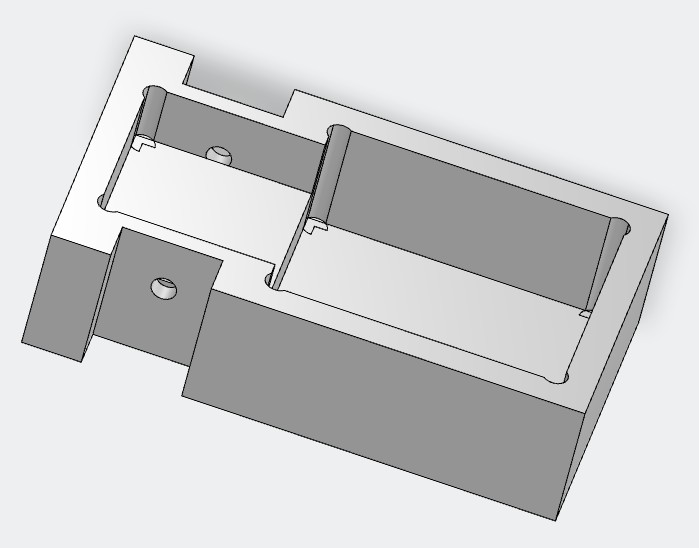
Having got to the point where my PA was working well I was keen to move forward with getting it into a suitable enclosure. A club member offered to 3D-print the two enclosures for me so that I could validate my design / dimensions etc before paying to have metal cut.

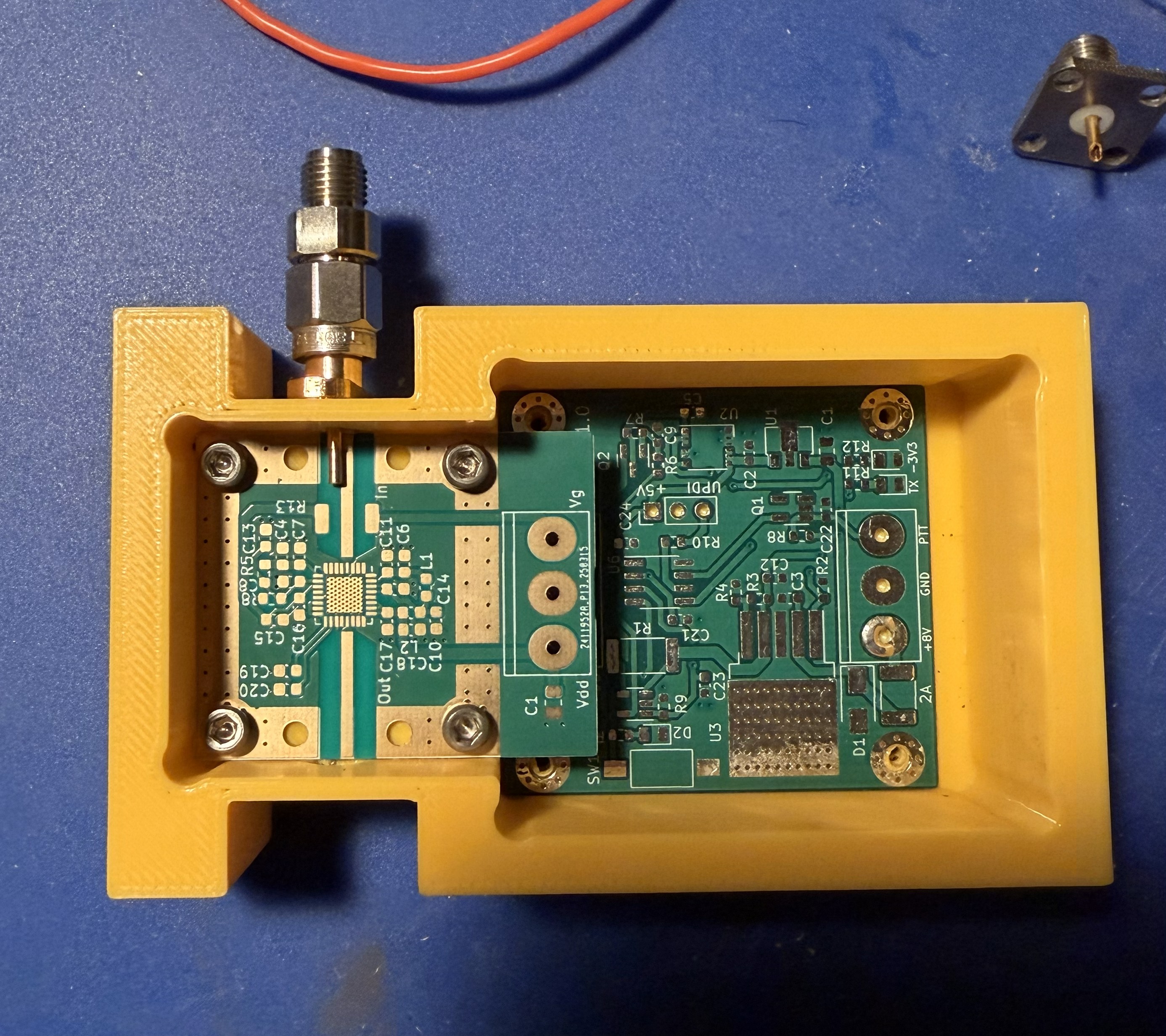
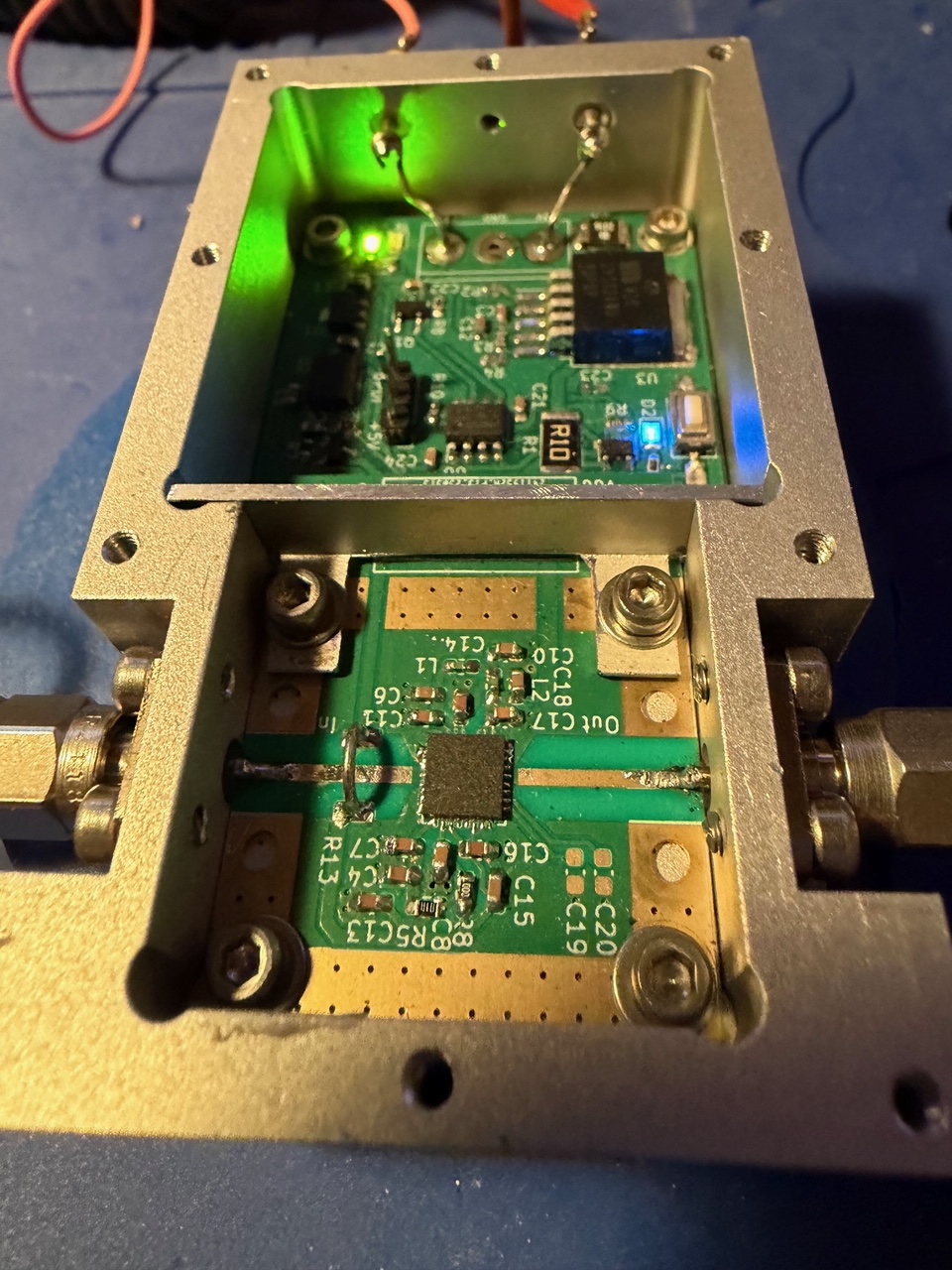
This proved to be a very worth while exercise as somehow I had managed to position the holes for the SMA connectors incorrectly! They did not align with the RF tracks as can be seen in the following photo:

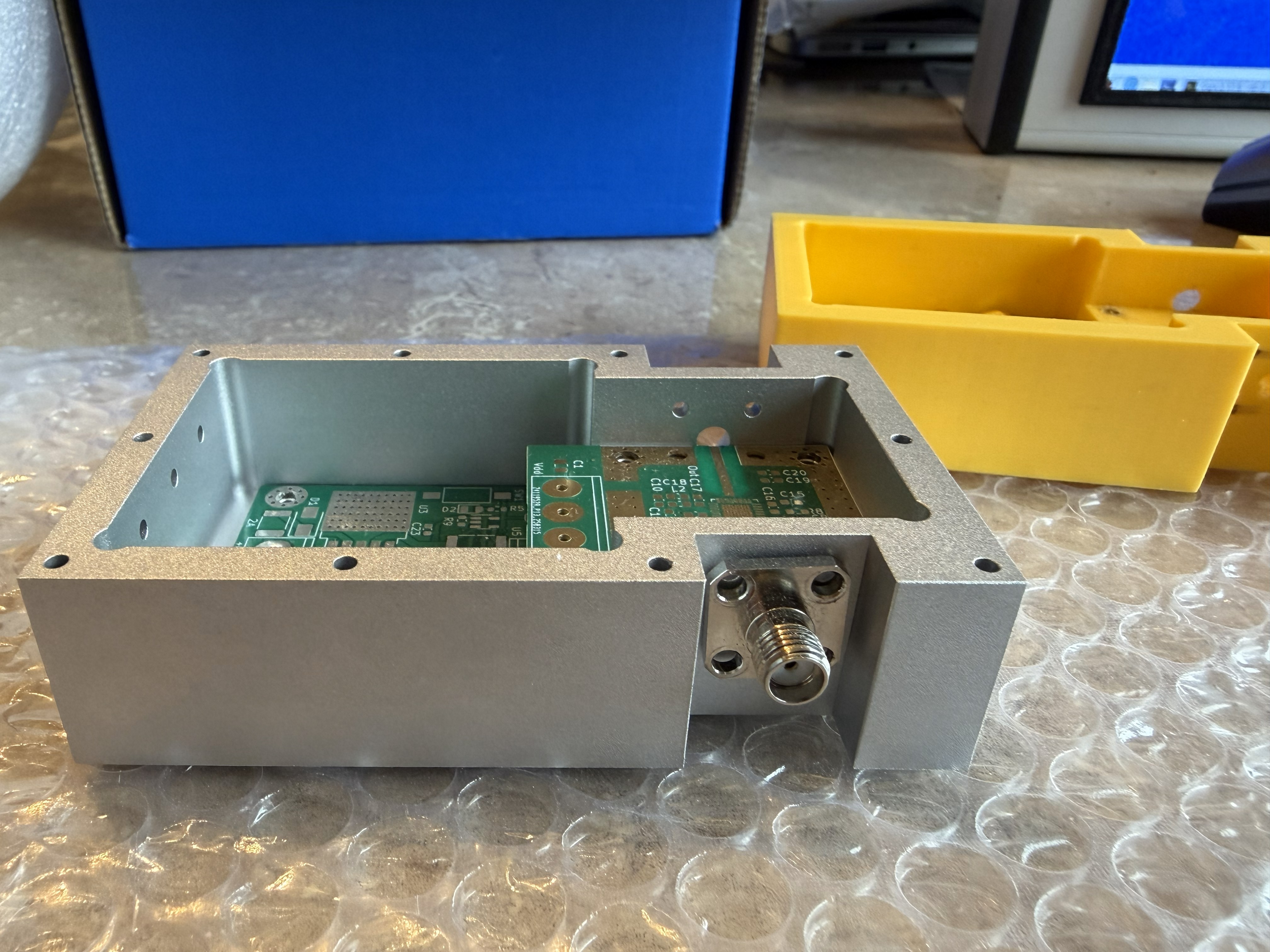
I soon fixed that and a step file was uploaded to JLCCNC.  They were offering a discount on shipping at the time which I took advantage of and one week later I was examining my first CNC machined part.

I opted not to have any of the holes tapped, this helped keep machining costs down, but it  meant that I had 26 holes to tap! Fortunately all went well and I soon had the boards fitted in the prototype enclosure and everyting ready to run some tests.

The tests did not go well! I had the input and output configured just as before, but the PA had become an oscillator, even without a lid. Using a small sheet of aluminium as a lid with a piece of absorber material on the underside made little difference. Several hours were spent trying to tame the beast. I got it to a point where with a 2dB SMA attenuator directly on the input to the PA it appeared to be conditionally stable.

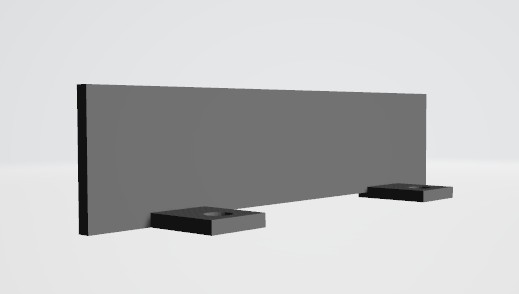
It was then suggested that I try adding a screen between the two sections to see if it helped. Fortunately the position of the PA board meant that it was a fairly easy thing to do and it could be held in place by two of the fasteners. I made the screen from a small piece of 1mm thick Ali angle.

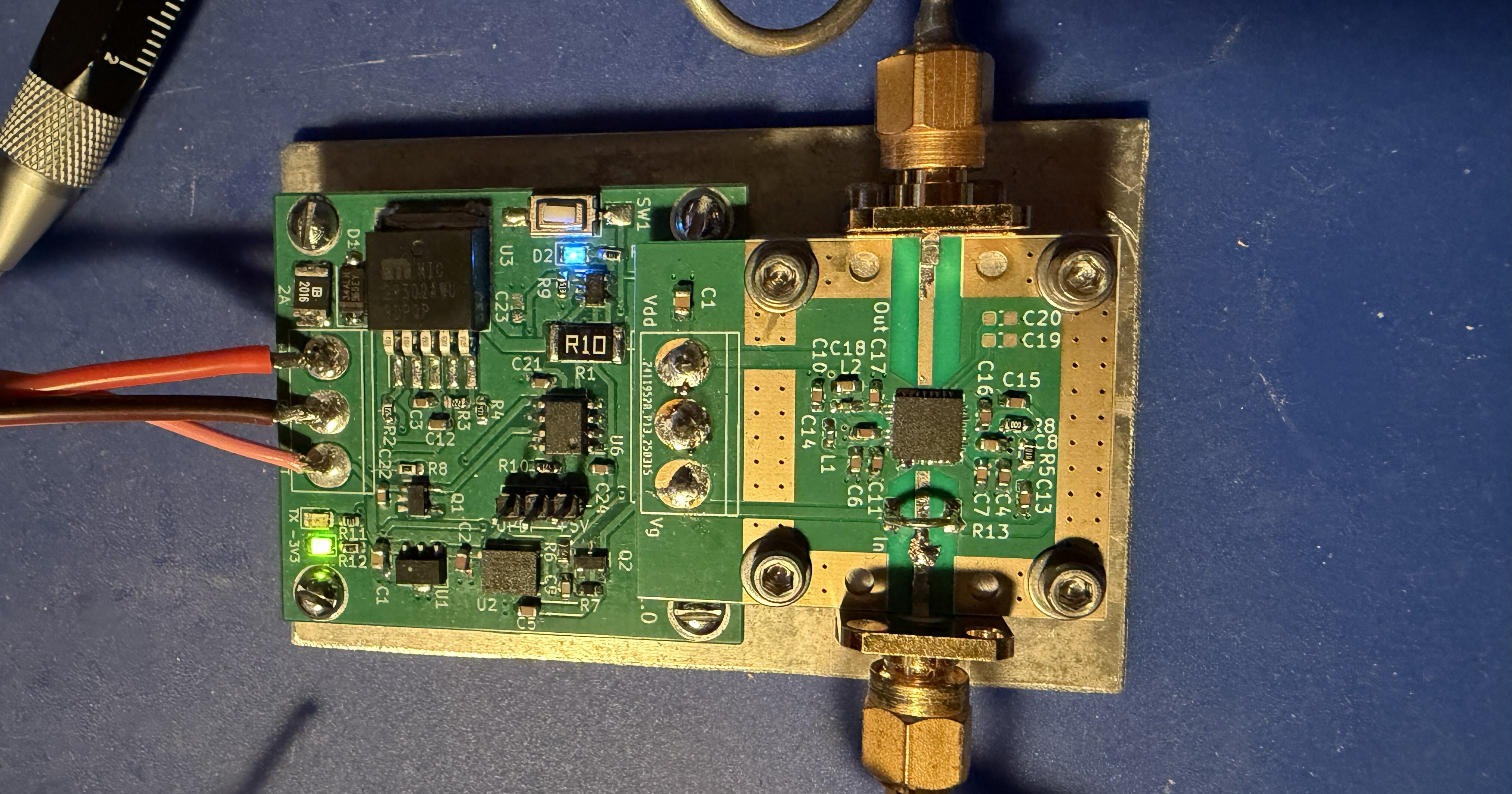
The photo below shows the screen fixed in place:

This changed things completely, with the screen in place and the piece of absorber on the underside of the lid the amplifier no longer oscillated.

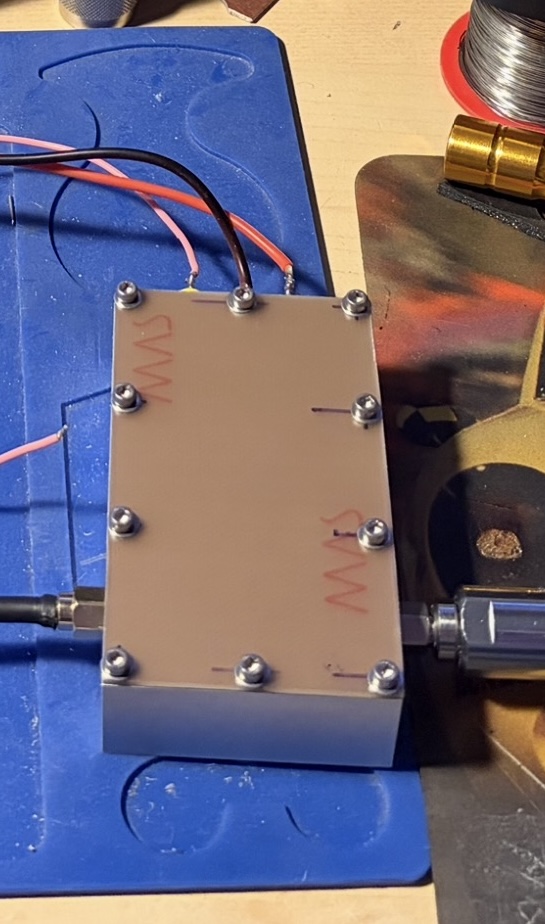
Here’s the PA with its lid fitted, going through a series of tests with different lengths of semi-rigid connecting cables, SMA to WG transitions and feed horns.

For now the lid is simply made from an old offcut of PCB material. Aside from a fancy Ali lid it’s basically complete, working and going to be used as final stage of a homebrew transverter.

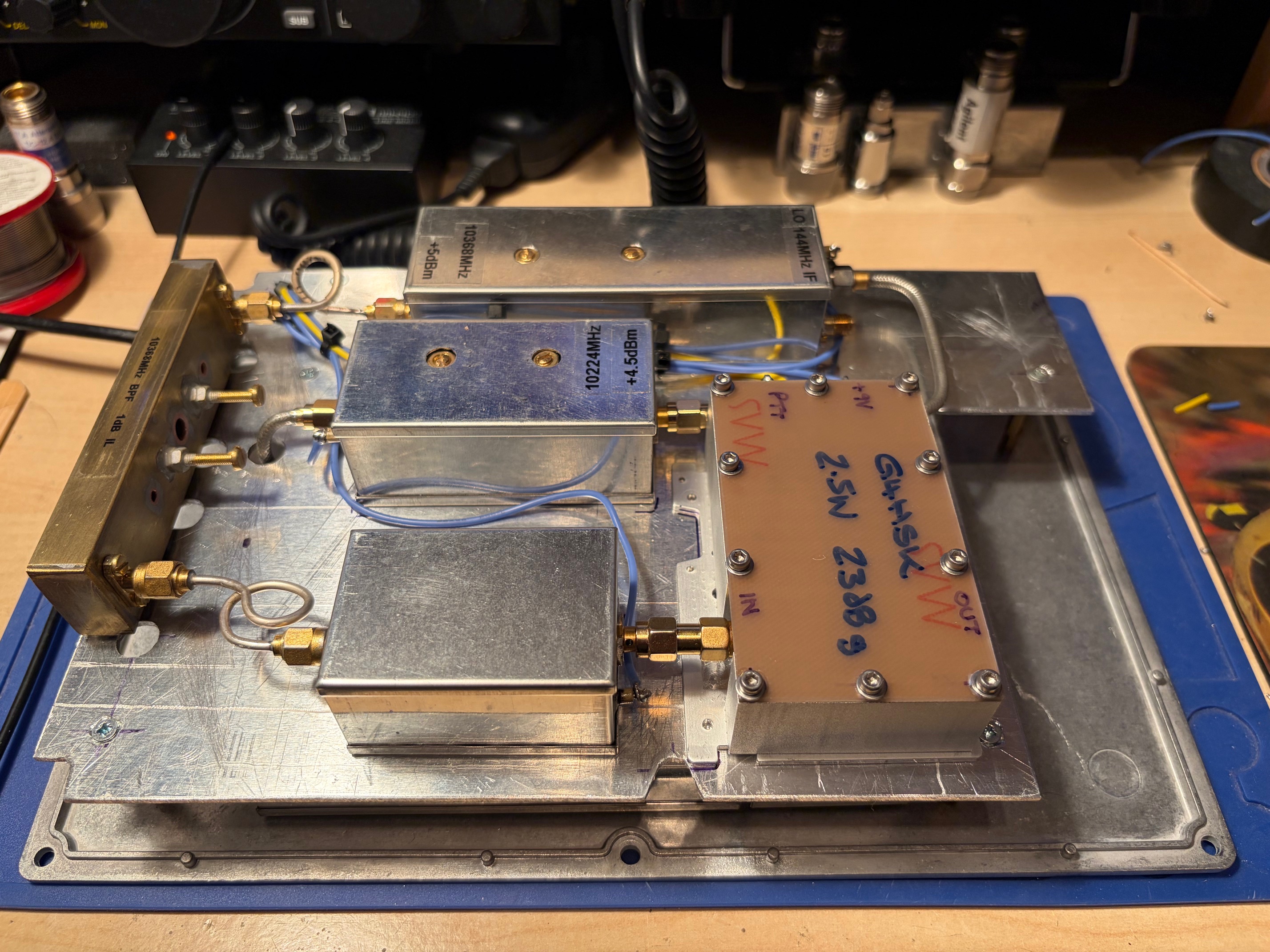
Here’s the new modular transverter with the PA, a mix of old school with new GaAs MMIC PA that’s currently measuring 2.5W output, 23dB gain:

Acknowledgements:

  • Thanks again to Kent – WA5VJB, Maarten – PA0MHE and Rens -PA3AXA (and possibly others I’m not aware of) for their part in this project. All the information needed, i.e. BOMs, Gerbers, ATtiny SW etc can be found here.


Posted in 3cms, Blog, GHz_Bands | Leave a comment

10GHz PA Using a Mini-Circuits PMA5-123 3W MMIC

I first read about the Mini-Circuits PMA5-123 3W GaAs MMIC device on the UK-Microwave forum early this year. Thanks to the efforts of Kent – WA5VJB, Maarten – PA0MHE and Rens -PA3AXA  (and possibly others I’m not aware of) several of us came away from the Martlesham Microwave Round table with one or more PA kits comprising of a PMA5-123 device and PCB.

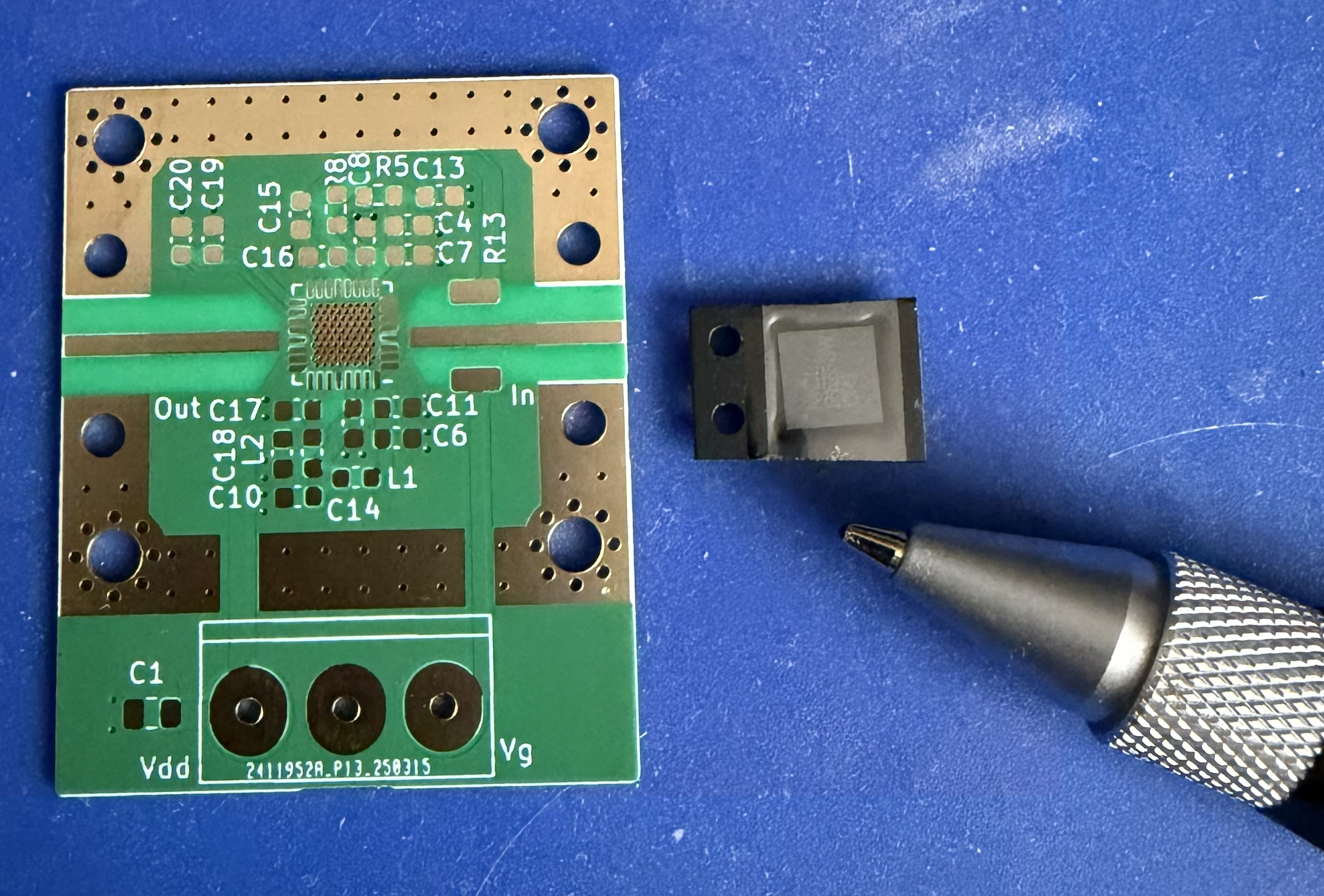
Like possibly many others I was surprised just how small this 3W rated chip was and immediately wondered how I was going to solder it in place. If you don’t already know, it’s a 5 x 5 mm 32 lead QFN style package, a small, thin, leadless package with electrical contacts on the bottom surface.
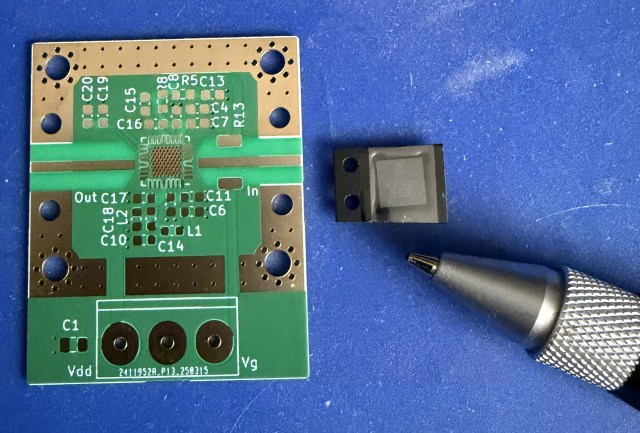
PMA5-123 Chip with Ball Pen For Size Comparison

Having no experience of working with such devices I (and maybe many others by all accounts) decided to wait and see how others got on soldering them in place and what sort of power out they were able to achieve. To date there appears to be very little information online detailing output power, sucessful / unsucessful builds, other than what I’ve seen here.

During a QSO on QO-100 with Chris – G8BKE we established that we had each got these kits and were both wanting to get on and build a working PA. Following an exchange of emails where I learnt some tips on how to hand solder the PA device I placed an order for a small number of DC-bias boards and we both started to gather the additional parts needed.

The DC-Bias board ensures that the PA state is managed correctly when powering on / off and between RX/TX. It also has a calibration routine to set a defined Iq and maximum Id value. All this is controlled by an onboard ATtiny412 MCU. Fortunately the control software was also made available, but how to program the ATtiny412 was another unknown to me.

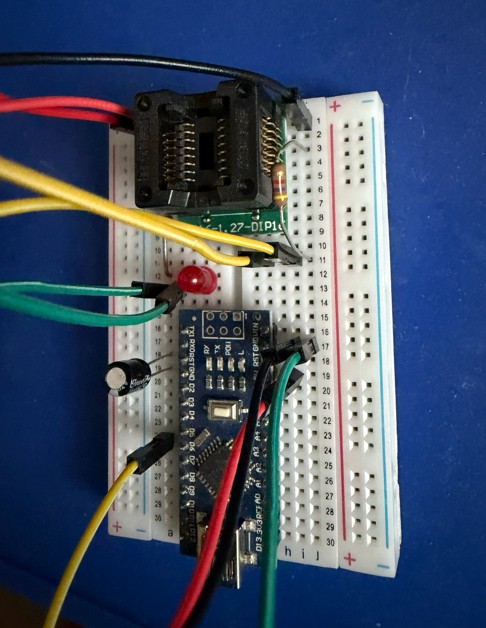
While waiting for all the parts to be delivered I read up on how to program an ATtiny chip using an Arduino Nano as a UPDI programmer. Several different articles described how to do this, all with varying amounts of detail, I chose to follow one by Electronics-Lab. I wanted to be able to upload the program to the ATtiny before soldering it in place. A special adapter (SOP8/16 to DIP8/16 socket) was purchased to be able to physically connect the ATtiny chip to the breadboard based Arduino UPDI programmer. To prove that things were working,  an LED and resistor were also added so that a simple “Blink Sketch” could be uploaded to check that everything was working and the LED did blink.
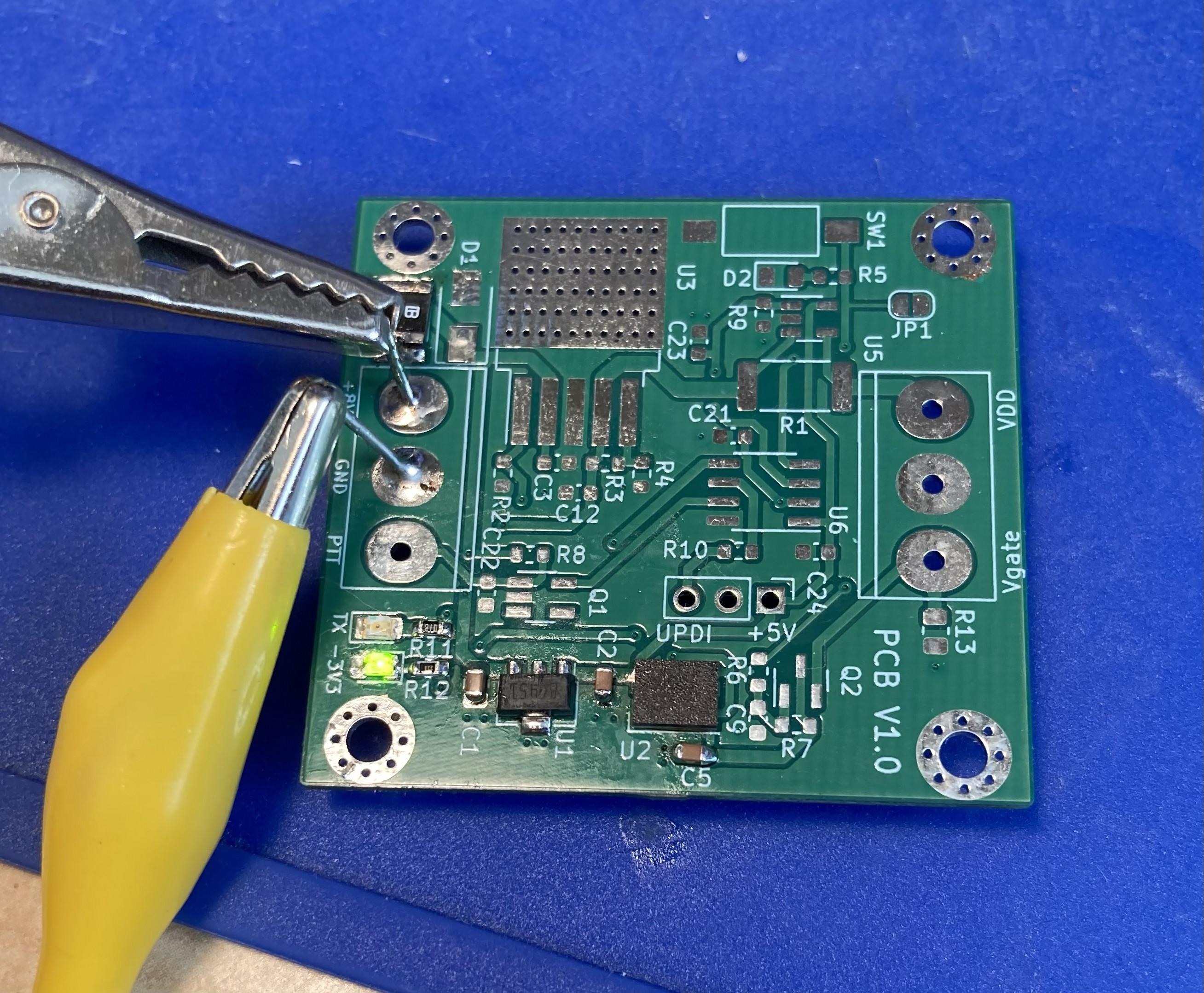
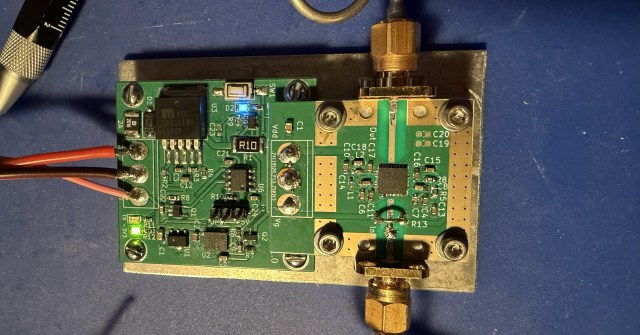
With the exception of the DC-DC chip that’s used to provide the negative Gate volts I then soldered both the PA and DC-Bias boards by hand. As all the contact pads are on the underside of the DC-DC chip I needed to use a hot air gun to mount that component. For this reason the DC-DC chip was the first component to be soldered in place. A small number of SM components were then added to be able to test that the chip had soldered successfully and the Gate supply was working correctly.
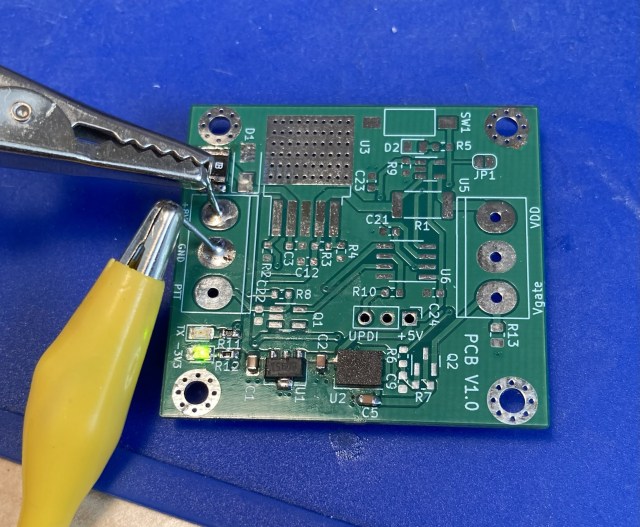
Photo showing DC-DC negative Gate volts supply being tested as first stage of build and before any board cleaning!

Both boards use QFN devices and the majority of other parts are 0603 sized which proved to be right on the edge of my hand soldering capabilities nowadays. But with patience, a good iron and lots of flux both boards went together without too much grief. The DC-Bias board was tested to ensure that the negative Gate voltage was present at all times and Drain volts were correct when the PTT line was grounded. A large fixed resistor was also used as a temporary load to “stress test” the Drain supply to 1A.

Once the basic checks were completed the DC-Bias board was connected to the PA, 2 SMA 50R dummy loads were put on the input and output of PA. With a current meter in the power lead and 9V applied the meter showed approximately 50mA. At this point the Blue LED was flashing to indicate that the calibration had not been done. The 9v supply was disconnected, the calibration button on the DC-Bias board held down and the 9V reapplied. This initiated the calibration routine, the TX LED came on until the calibration was completed and the memory updated. Once this had been done the PTT was grounded and the meter showed the expected 450mA. This was a very pleasant surprise as I should confess to having to remove and resolder the PA chip as I somehow managed to mount the thing 90 degrees out the first time! Fortunately I noticed this after I cleaned the board with IPA and before any volts got near it.

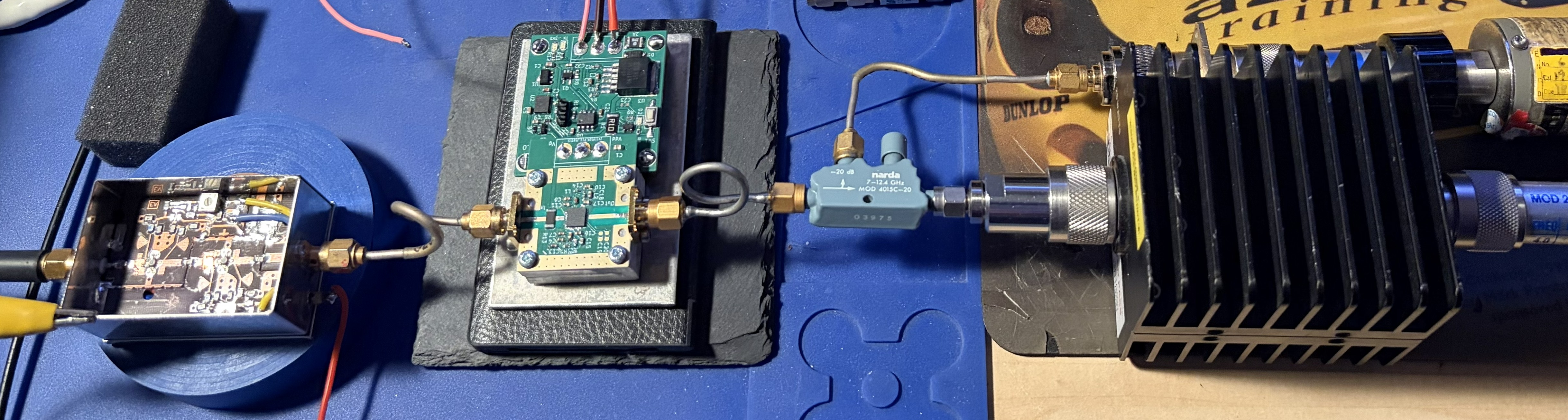
What followed next was a series of tests and measurements with various drive levels between 0 to +14dBm. For this I used my test source plus a “Franco” amplifier board with various fixed attenuators. Power measurement was done using an HP432A + sensor.
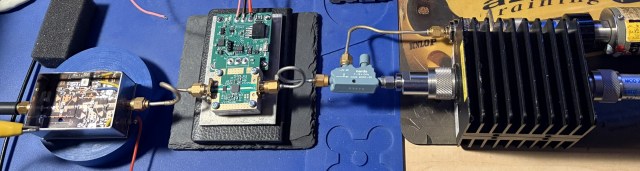
Initial test setup. PA heatsink 30x28x12.5mm Ali block.

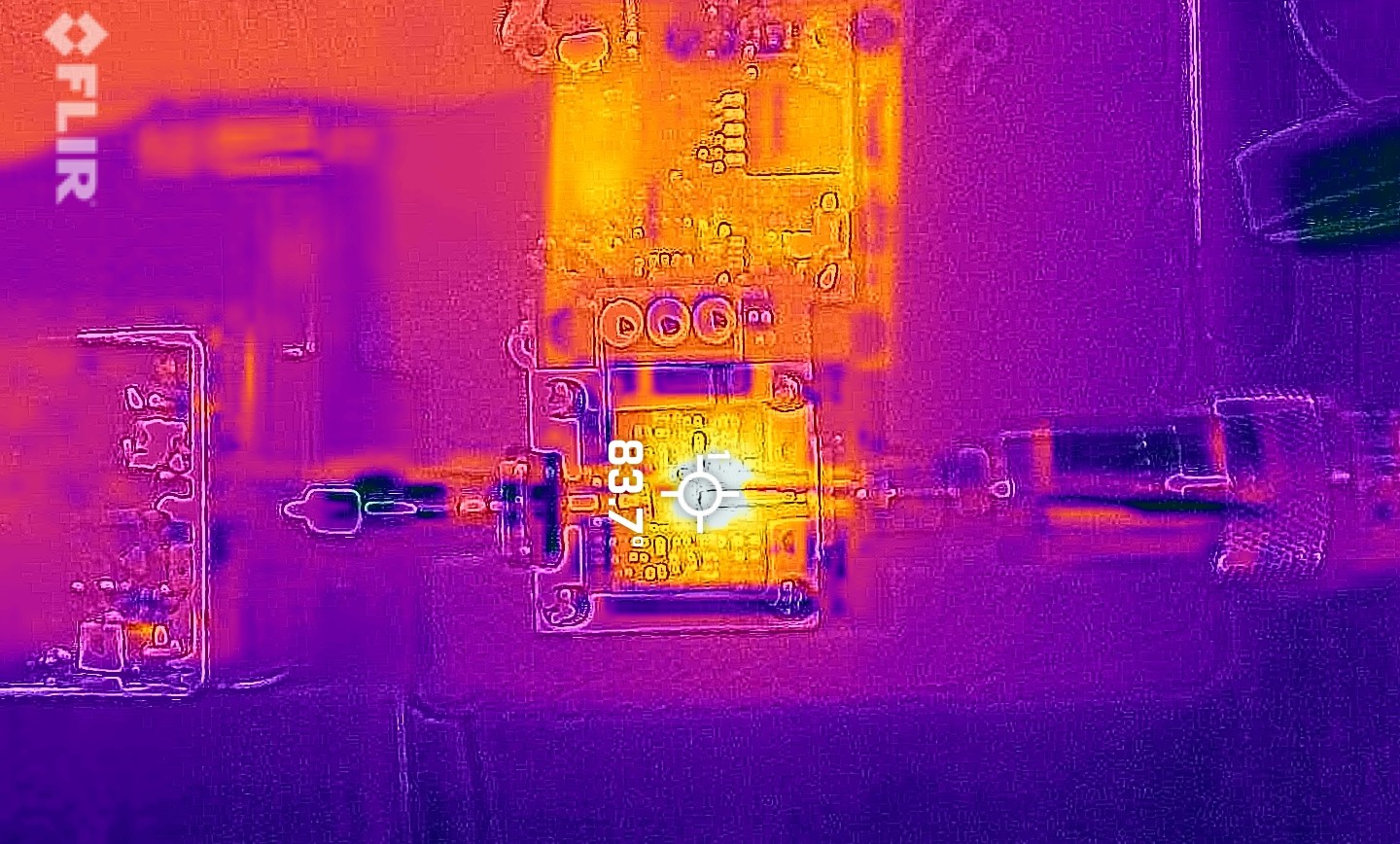
With the Iq set to the programmed default 400mA and IdMax at 1.25A I struggled to get more than 1.1W out and the gain was way below an expected value of around 26dB. I then experimented with different Iq settings and reached a point where I was seeing almost 2W out. Increasing the drive would cause the Drain current to exceed IdMax (1.25A) and the DC-Bias board would trip to fault mode.
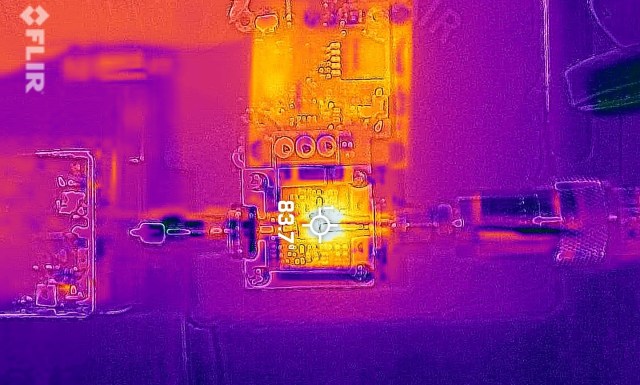
A very quick look at temperatures. 1.5W out.

After an exchange of ideas via email, a number of small changes to the PA board and ATTiny SW were made which resulted in significant improvements. The PA is now producing 2 – 2.5W with 24dB gain which is ideal for it’s intended use as a PA for my modular 10GHz TVTR.

The following changes were made:

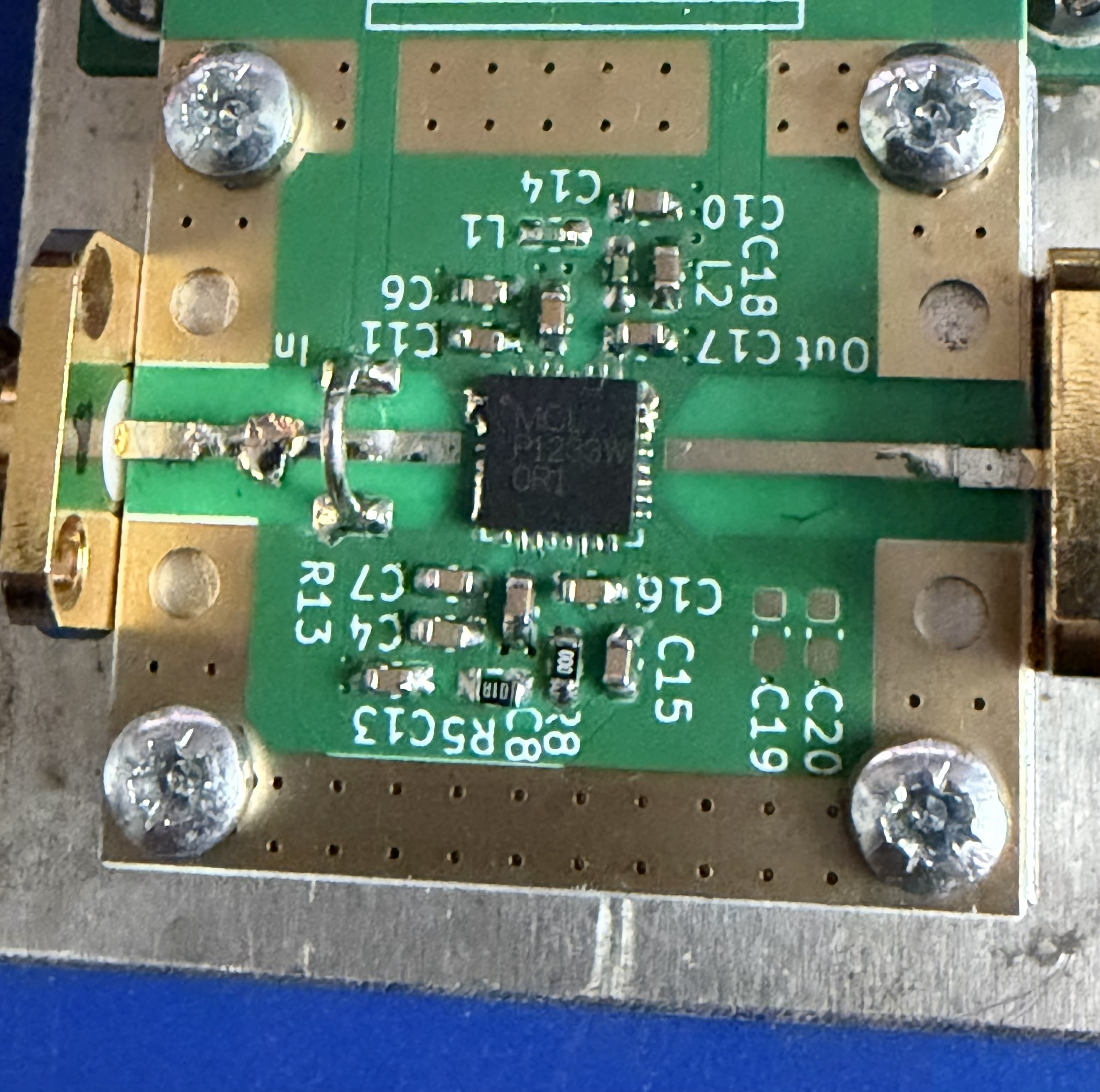
  • R13 0R chip resistor was replaced by an elevated wire bridge. This improved the impedance / match and resulted in almost 2dB extra gain.
  • A small snowflake (piece of copper foil) was added to the input track which improved the impedance / match resulting in a small increase in gain.
  • The Iq value in the software was changed to allow Iq=500mA
  • The IdMax value in the software was changed to allow Id maximum of 1.5A
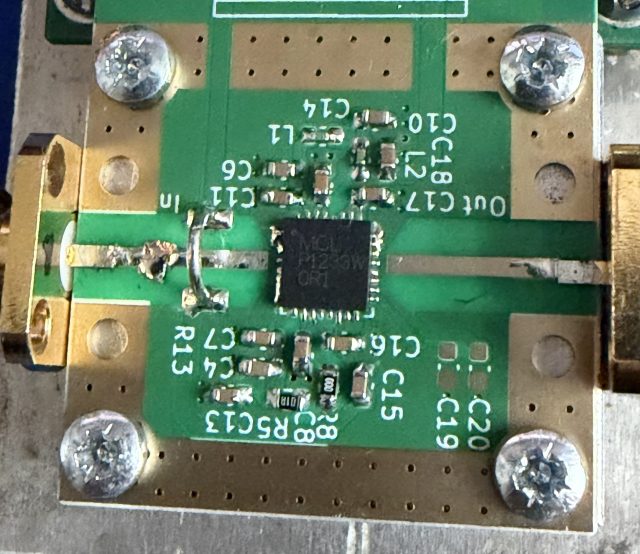
Photo showing snowflaking and wire bridge modifications

The results so far are very encouraging, with an output of typically 1 to 2W it should make a nice PA for many of the transverters that are in use today. Will it give more output, I’m sure it would, but for how long?? It’s a very small chip with an equally small surface area that’s in contact with the heatsink, so cooling is a challenge.

What’s next?

  • The PA needs some form of enclosure, I’m currently exploring two possible solutions, one just for the PA board and another that houses both boards.
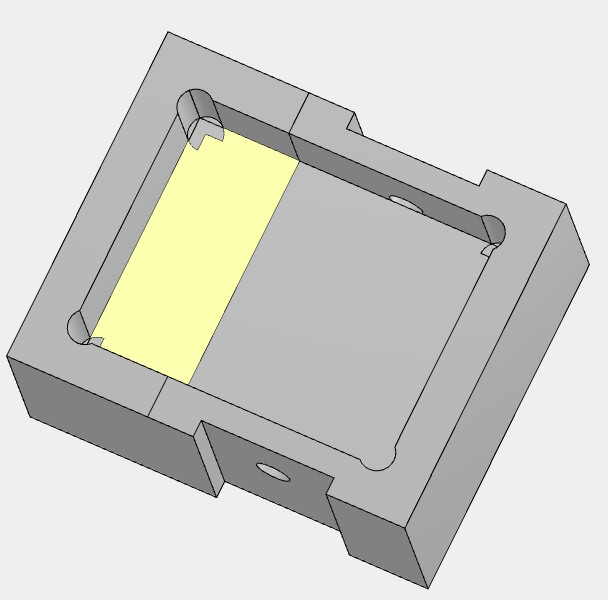
Option 1 PA Only, 50x40x22mm with 12mm thick floor for heatsink
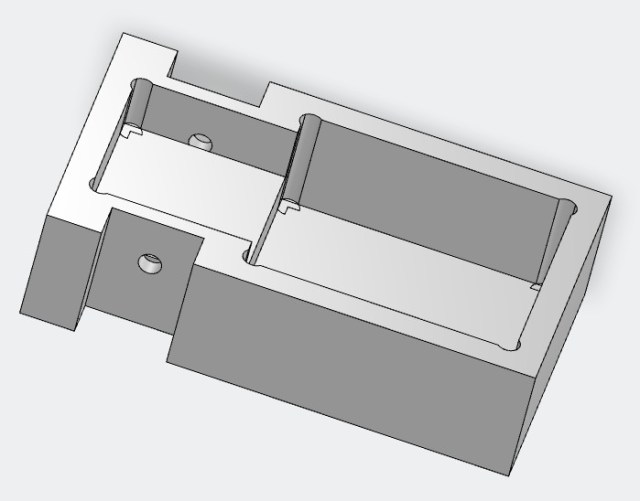
Option 2: PA and DC-Bias boards. 85x50x22mm with 12mm heatsink section under the PA board.

  • Do further tests / measurements both RF and temperature once the PA is fitted into an  enclosure.
  • Add this to my modular 10GHz TVTR and shoehorn everything into the waterproof housing that has sat gathering dust for far too long.
  • Build an Arduino controlled hot-plate to (in theory) make the soldering of QFN devices so much easier.
  • Build the second pair of boards that I have sat here destined for my /P TVTR.

Acknowledgements:

  • Thanks to Kent – WA5VJB, Maarten – PA0MHE and Rens -PA3AXA (and possibly others I’m not aware of) for their part in this project. All the information needed, i.e. BOMs, Gerbers, ATtiny SW etc can be found here.
  • Chris – G8BKE for sharing this build experience with me.
  • Gus – G3ZEZ for producing the heatsinks.


Posted in 3cms, Arduino, Blog, GHz_Bands | Leave a comment

Fun on 10GHz – 2025 ARRL EME Contest

I was QRV on 10 GHz in the ARRL contest but had only limited time each Moon pass due to other commitments. A total of 15 stations were worked in the first leg:  OZ1FF, OZ1LPR, ON5TA, DL4DTU, LZ4OC, OH3LWP, F2CT, IW2FZR, DJ7FJ, N1AV, KM0T, OK1DFC, F5JFW #49, OK1AQ and G4YTL.

Then after the contest weekend, on Aug 19th I worked Hans, PE1CKK for #50, a very pleasing milestone.

The second leg of the ARRL contest resulted in an additional 7 stations: W3SZ #51, IK0HWJ, IK6CAK, PE1CKK, VE4MA, PA0PLY and SA6BUN. Making a total of 22 stations worked overall, which was up on last year. I tried hard for KL6M who was -14 / -15 with me but my 10W just didn’t cut it.

250913_095000 10368.080 Rx Q65-60D -15  2.8  997 CQ KL6M BP51     q3
250913_095200 10368.080 Rx Q65-60D -14  2.8  993 CQ KL6M BP51     q3
250914_100200 10368.230 Rx Q65-60D -16  2.9  995 CQ KL6M BP51     q0
250914_100400 10368.230 Rx Q65-60D -15  2.9  990 CQ KL6M BP51     q3

Changes made a couple of months back to the 10 GHz enclosure / PA heatsink (to improve cooling) appear to have improved things. I can now run tests for extended periods even on those very hot days we have experienced again this year.

It’s good to see the number of small dish stations increasing on 10 GHz.

Many thanks to all my QSO partners.

Posted in 3cms, Blog, EME, GHz_Bands | Leave a comment

G3WDG-002 10GHz Receive Converter

I recently finished building the G3WDG-002 receive converter, a project that I started around 30 years ago! At that time I purchased the G4DDK-004 LO and the G3WDG-002 kits to get started on 10GHz narrow band modes (SSB, CW).

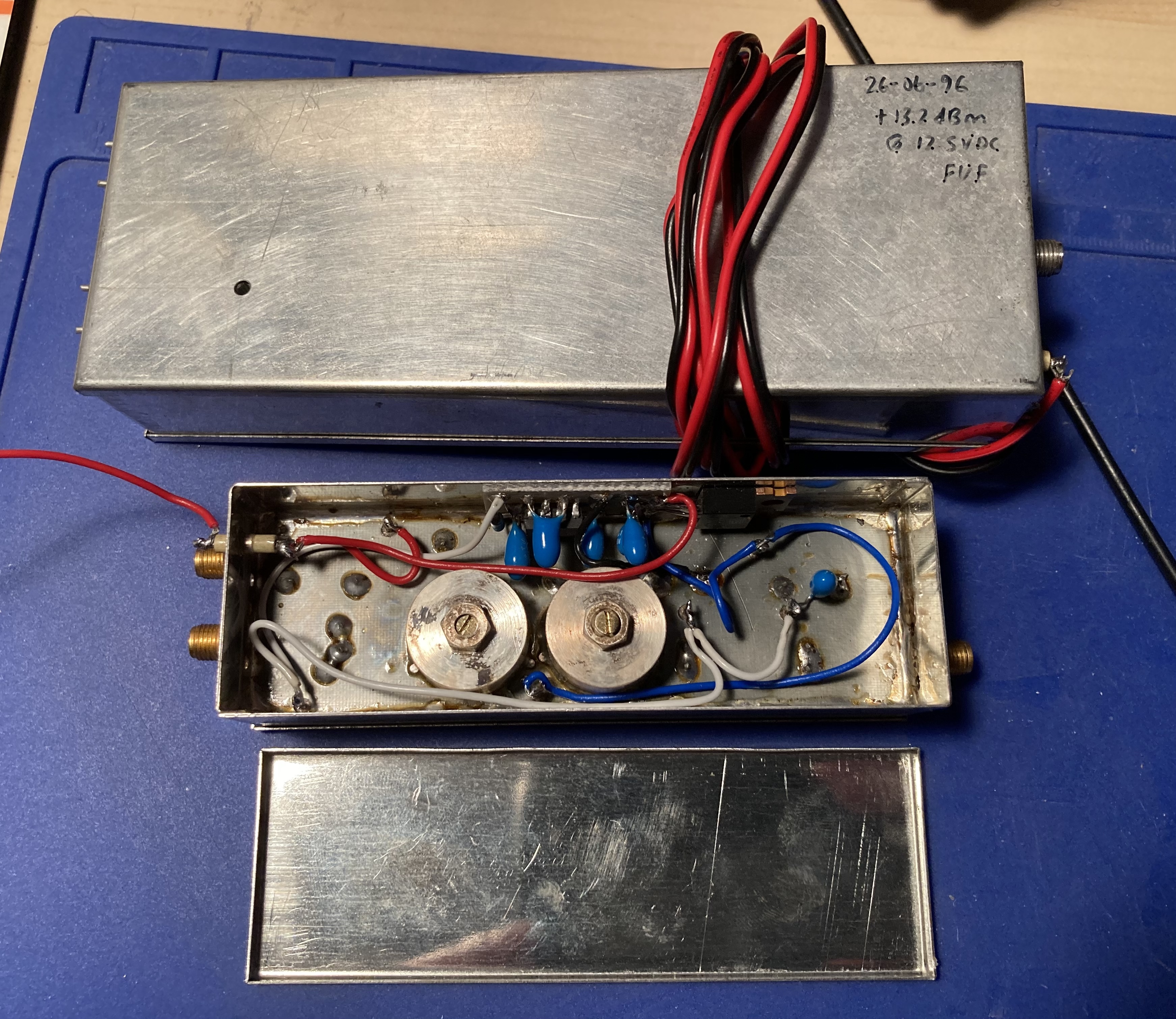
The G4DDK-004 module was completed, aligned and fully working (dated June ’96, as shown in one of the photos below). There was a small group of us building the G3WDG Transverter. One of the group was living very close to me and we were both working together to get our receive converters working. Sadly he became ill and went SK before we completed them. As a result, my partly built kit sat in a box untouched until last year when another of our group sadly went SK! He and I had been reminiscing and we had talked about these modules and how he had aligned and measured the output of my LO kit. It was then I decided that I really should finish what we had started together all those years ago.

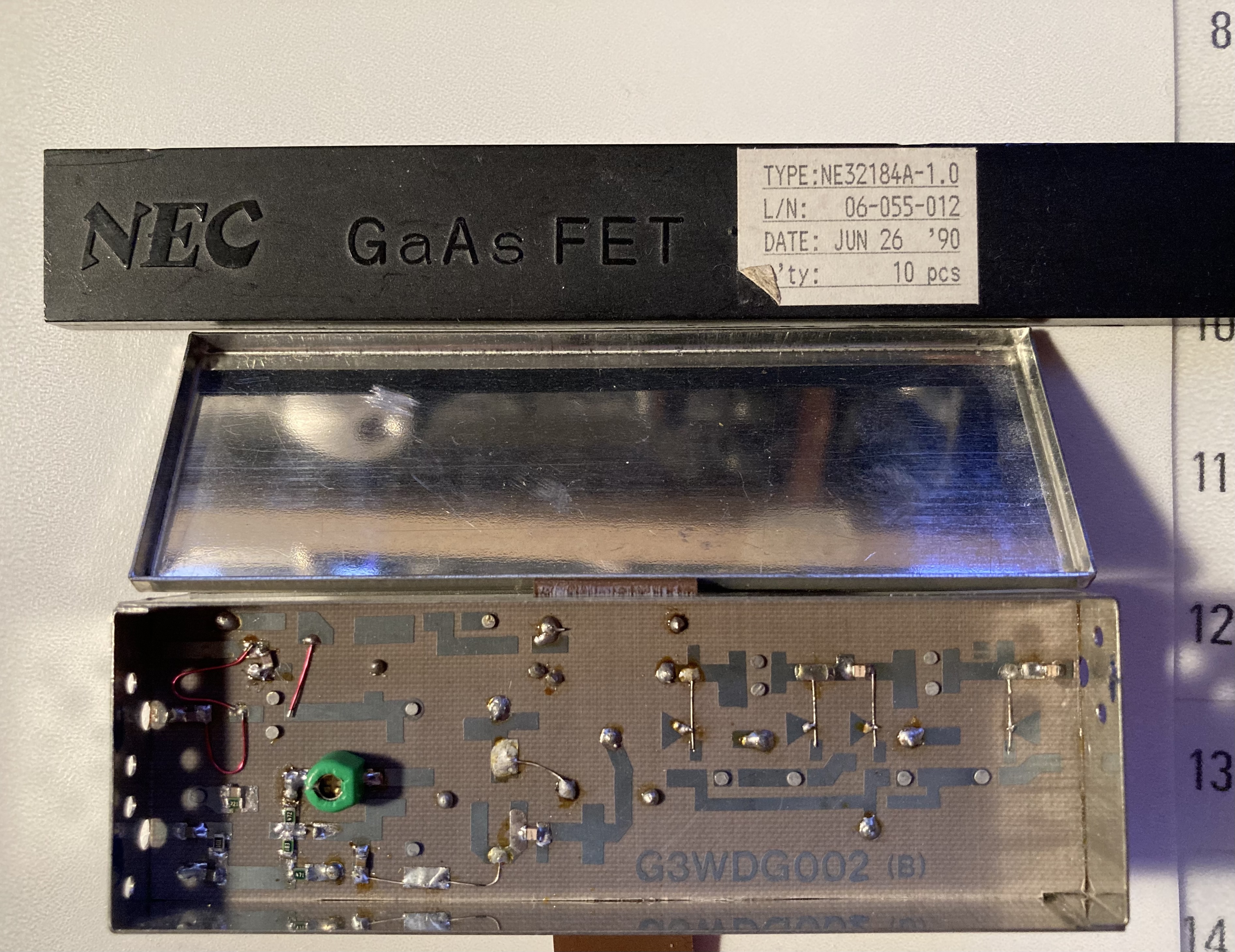
Whilst I still had the box of parts and a partially completed converter I was missing the build  documentation. Fortunately a quick online search resolved that issue and I found all I needed here… thank you Dave. Checking the parts list I found that I was missing the 2K2 preset pots and I didn’t have the required Birkett red or black spot GaAs FETs. Fortunately I did have the mixer diode and a packaged strip of 10 NEC NE32184A GaAs FET devices. I guess someone at the time, with far better knowledge than me, decided that these were a good option.

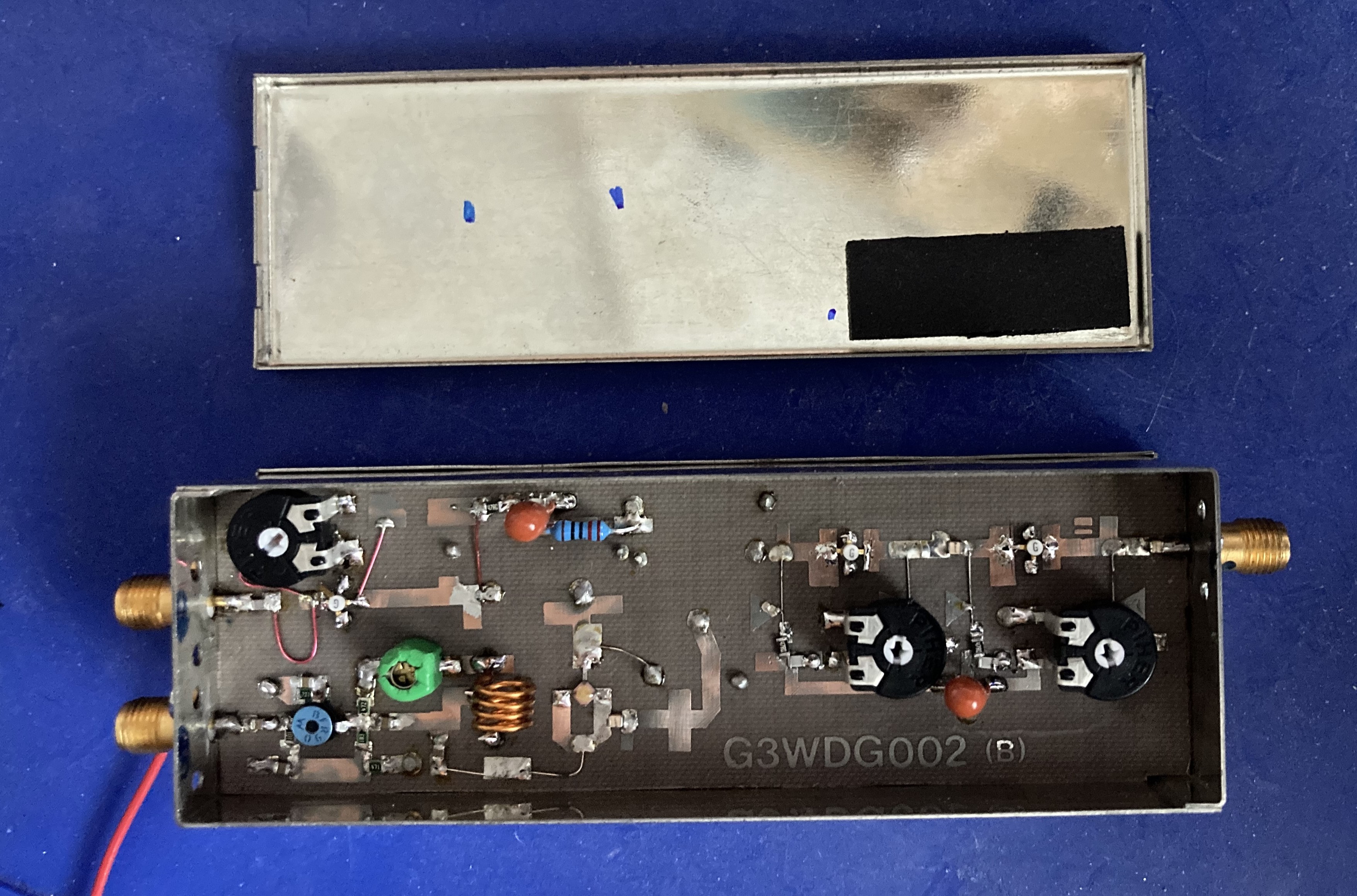
The part built receive converter:

Surprisingly the board and tin box enclosure were in very good condition as were the filters mounted on the opposite side of the PCB. The PCB tracks were all tarnished and needed to be carefully cleaned with a glass-fibre pen. Once this was done, I soon picked up from where things had been left off all those years ago, and continued on, following the excellent build instructions. It all went together without any issues.

The documentation warned against part substitutions, so the use of different FETs was a bit of an unknown. I used the G4DDK-004 LO and followed the alignment instructions. Each alignment step resulted in what was expected and I could receive my personal 10GHz beacon.

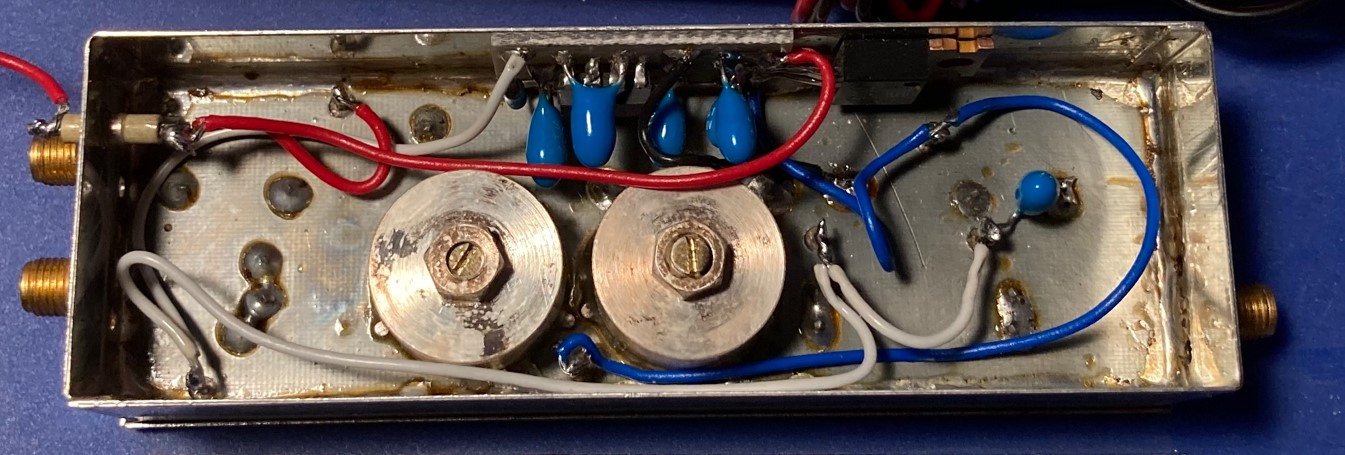
Here’s the completed module:

The NE32184A devices worked fine, a small piece of RAM was needed on the underside of the lid to stop some oscillation when the lid was fitted, but that was documented in the assembly / alignment notes and fully resolved the issue.

The photo above shows the G4DDK-004 module which produces the 2256MHz LO needed for the receive module. The 2556MHz being derived from a 106.500MHz crystal fitted with a Murata posistor crystal heater. I modified this unit for injection locking using an ADF4351 SynthShield and 10MHz GPSDO reference. This is working very well.

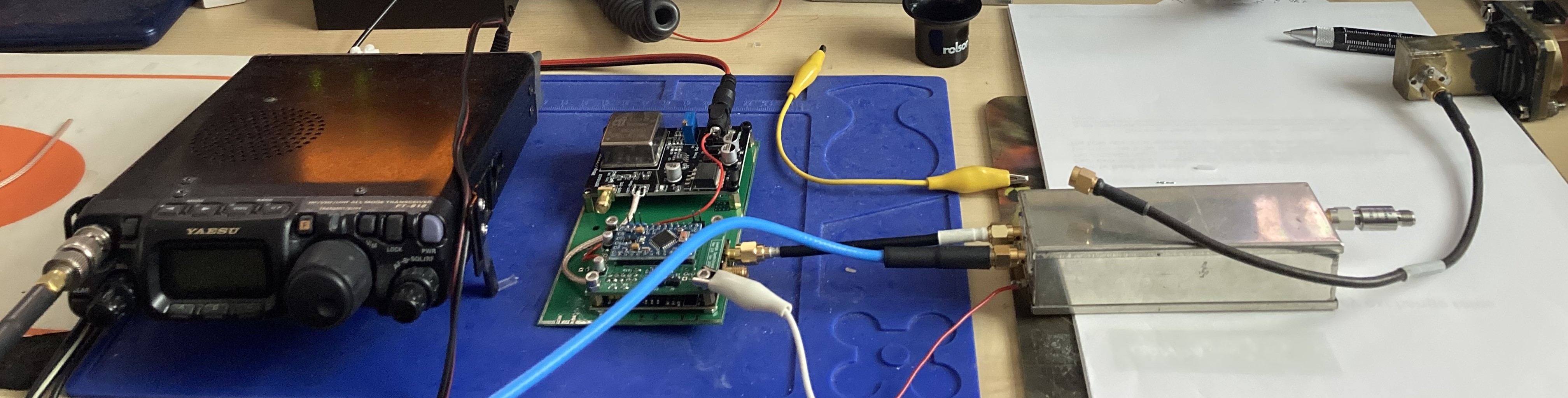
As the ADF4351 is capable of generating 2556MHz itself, I’m currently experimenting with an alternative LO setup. Tests so far are proving to be good. The LO output level is much lower with the ADF4351 (+3dBm compared to +13dBm) so further tests are needed to see if a small amplifier will be needed.
The new LO setup can be seen in the photo below:

Once this new LO is put in an enclosure I will add an SMA input socket and power switching so that the ADF4351 SynthShield can work with either an external 10MHz GPSDO reference or the internal 10MHz OCXO.

So far testing has been rather limited but all the indications suggest this receive converter is working well. It will be very interesting to compare it against the typical setups in use today. I’m particularly keen to see how it compares with my modular 10GHz /P TVTR.


Posted in 3cms, ADF4351, Arduino, Blog, GHz_Bands | Leave a comment

QO-100 / 10GHz DownConverter Update

When building my modular 10GHz /P transverter I identified a number of areas where some minor changes could potentially improve the overall performance and build experience. As I plan to build another 10GHz transverter to go up on my main mast I decided to implement some of these changes.

The first area I focused on was the downconverter, identifying the following changes:

  • When used with a standard LNB, add the ability to supply the LNB (via the onboard Bias-T) with  12V or 18V to allow for either vertical or horizontal polarisation.  With a reasonably sized dish this would allow both NB and WB reception from QO-100 and both terrestrial and EME 10GHz reception.
  • Support TX/RX switching by either, switching the PTT pin to ground, applying 12V to the PTT pin or providing 12V on TX via the transceiver IF coax connection.
  • Minor improvements around the 10MHz output and 25MHz filtering for the LNB injection locking.
  • Only one filtered 10MHz output was needed.
  • Improved PCB layout for better “fit” for a standard 74mm x 111mm x 30mm “German Tin Box”.
JLCPCB once again did a great job in producing the new boards. I however managed once again to add an “undocumented feature”… for some reason, still yet to be understood, the top layer silkscreen was missing the ID for each of the SMA sockets. Aside from that no other issues were found during the assembly of the first board.

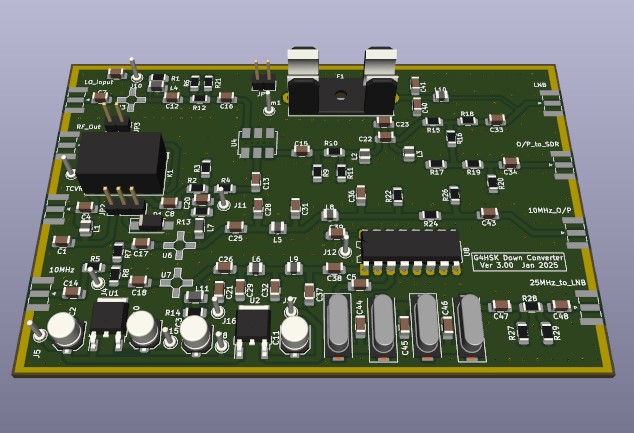
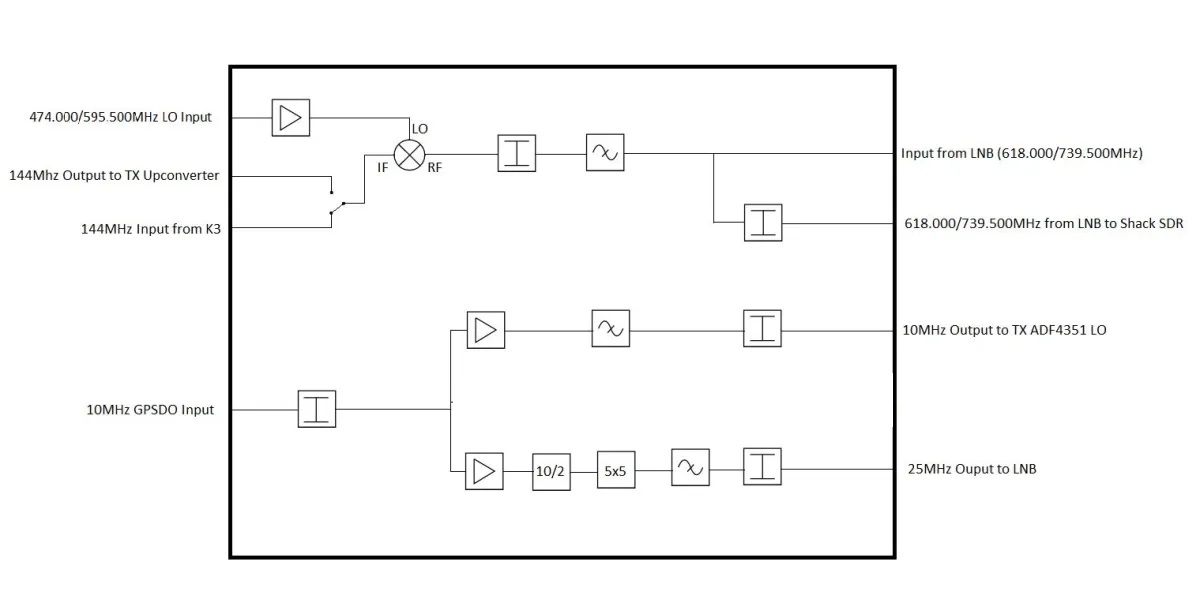
Here’s a block diagram of the downconverter:

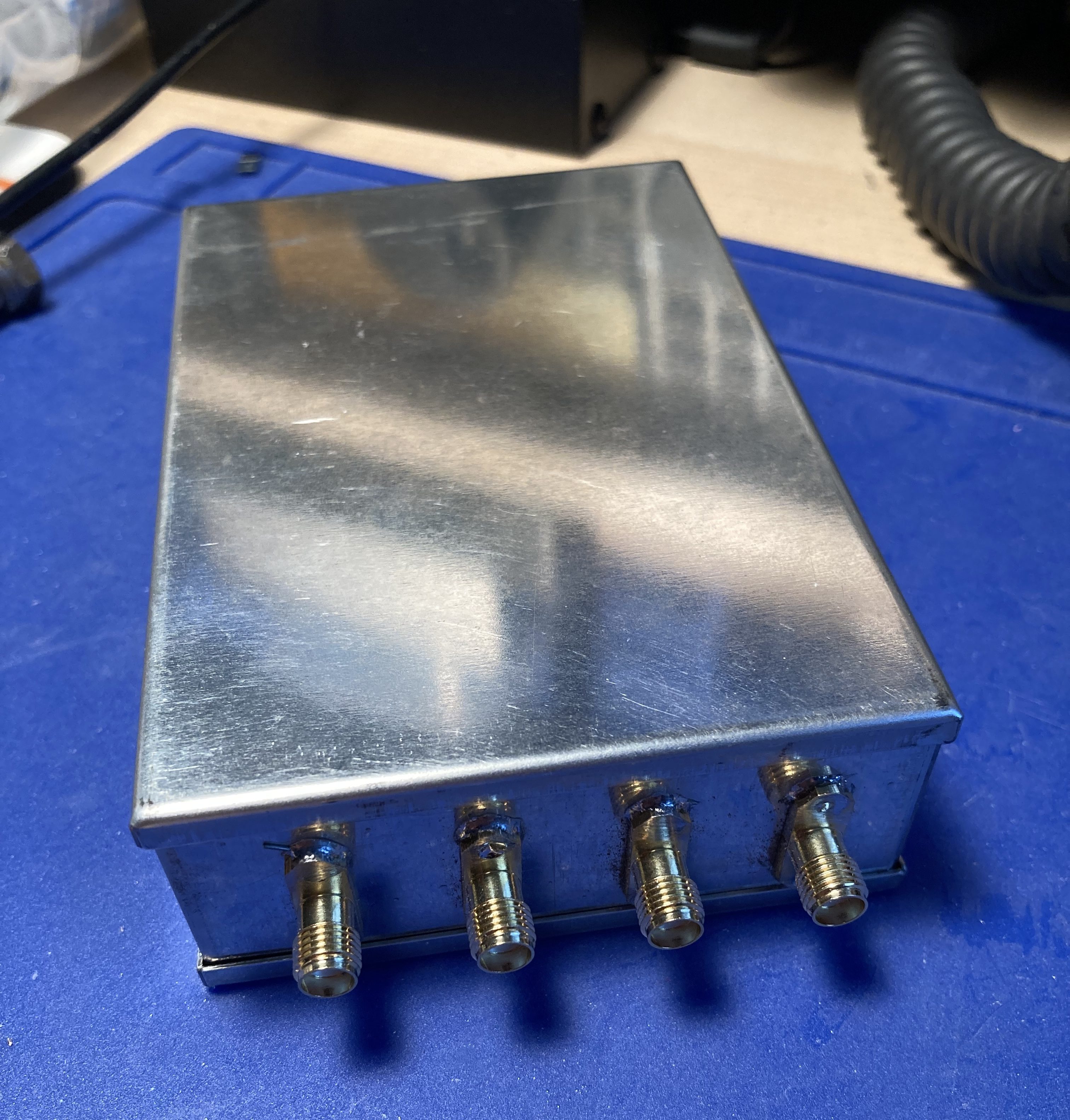
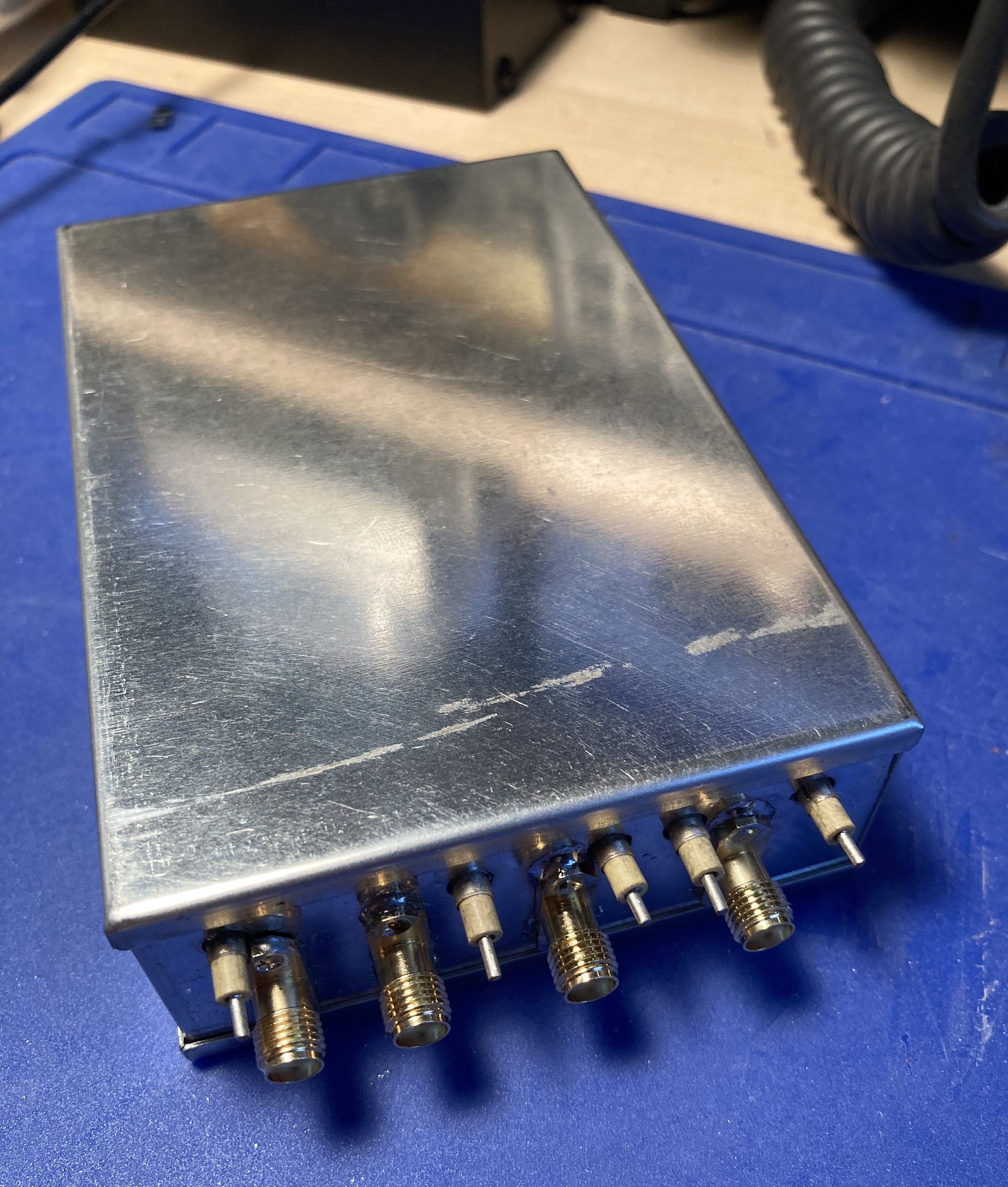
The following photos show the completed build to the new design:

G4HSK Updated DownConverter

The PCB layout / design also has the necessary pads for an attenuator in each of the RF paths to allow the optimum levels to be set for use with different LO, LNB and 10MHz TXCO / GPSDO units.

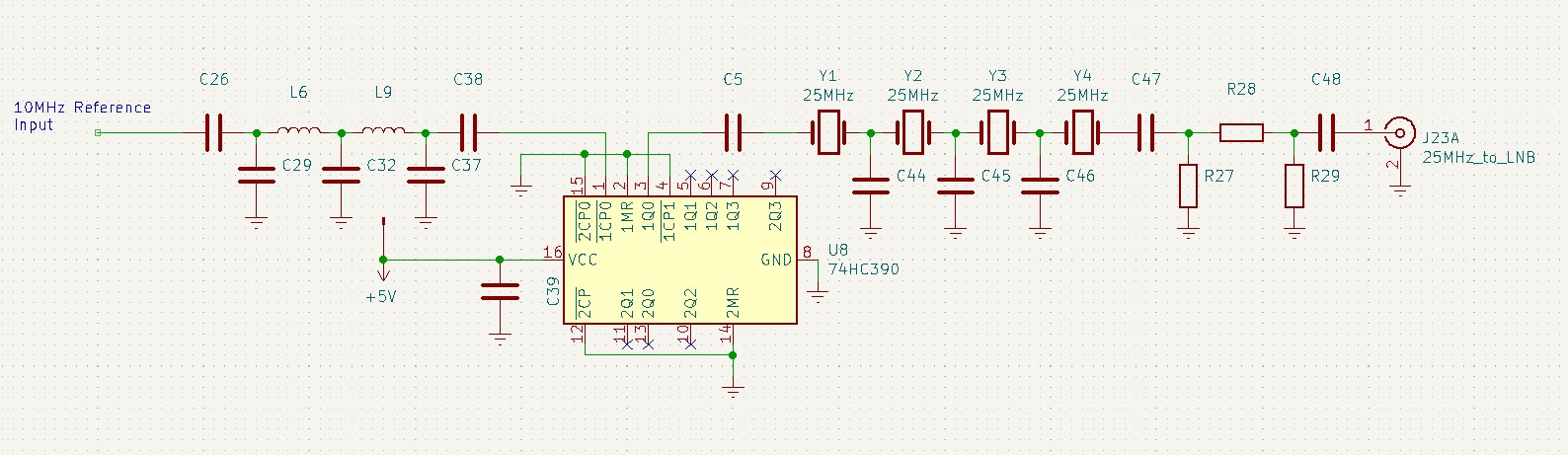
The 25MHz reference that’s used to injection lock the LNB is derived from the 10MHz reference input. A 74HC390 is used to divide by 2 and the 5th harmonic is then filtered using a 4-pole 25MHz crystal ladder filter. This results in a -3dBm output which I have found to be more than adequate to injection lock the various LNB units I have modified, YMMV 🙂

My initial tests have met all my expectations, I’m now looking forward to making some sun noise measurements with a modified Maclean MCTV-670 LNB frontend once the weather improves. 🙂


Posted in 3cms, Blog, EME, GHz_Bands, QO-100 | Leave a comment

Black ADF4351 Eval Boards

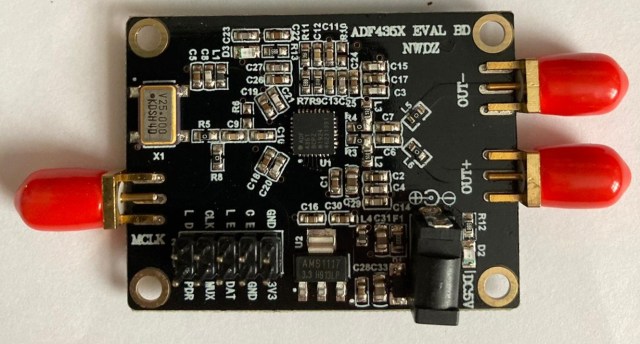
Having used a number of these readily available “black ADF4351 boards” along with an Arduino Mini-Pro and SynthShield PCB  in various projects I’ve learnt that not all the boards on sale are the same. They can differ both in component count  and physical layout. The board size, positioning of the SMA and power connection are pretty much identical, so from a quick look at a sellers Ad you’d probably not notice the more subtle differences.

So far I’ve seen the following:

  • The power connector pins can be in slightly different positions. This impacted the alignment of the power pins with the holes in the SynthShield PCB.
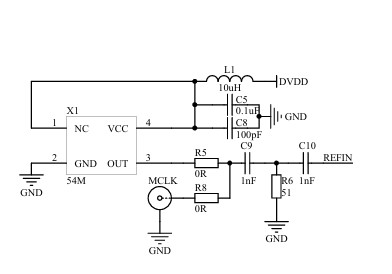
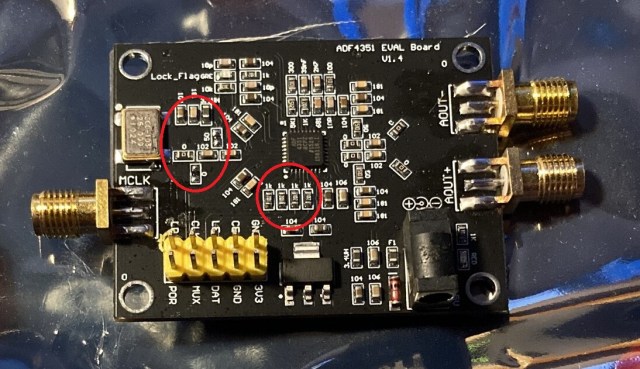
  • To disable the onboard 25MHz source on most of the boards I’ve used I simply removed two SMD parts, the 0R link (R5) and L1 (Vdd feed). An external Frequency source (usually 10MHz) could then be used via the MCLK SMA socket. Two boards that I purchased recently were missing a 0R (R8) on the MCLK input track to enable the external source to reach the REFIN pin on the ADF4351 chip. So in addition to removing the two components a 0R needed to be soldered in place.

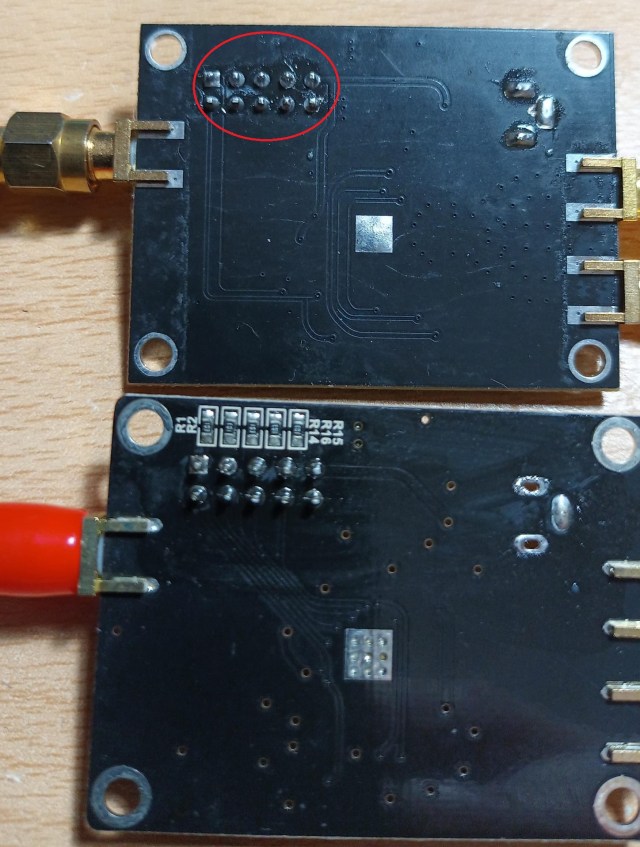
  • A recent request for help from someone on the UKMicrowaves Group Forum highlighted that some boards appear now not to have a pull-up resistor on the CE pin. The two boards I mentioned previously also had this issue, a 10K resistor (R16) was missing. Having learnt this I revisited a board purchased last year that failed to work and had been relegated to my “useful scrap parts” drawer. This board was also missing the pull-up resistor, adding a 10K R between the CE pin and +3.3V resolved the issue and now it does indeed work!

The following photos show some of the board differences:

The photos above and below show two boards that have had the standard power connectors removed in preparation for use with a SynthShield PCB and the different component layouts.

This photos shows the 0R (R8) not present.

None of the differences described here are a major issue, if you are aware of them.

Hopefully these notes prove useful, and another board doesn’t get assigned to the “useful scrap parts” drawer as mine did last year.  🙂

Acknowledgements:

  • Members of the UKMicrowaves Group for highlighting the missing CE pull-up resistor.


Posted in 3cms, ADF4351, Arduino, Blog, GHz_Bands, QO-100 | Leave a comment

Fun on 10GHz – Adding a Panadapter to the /P Gear

Since completing my 10GHz /P TVTR I have been using it indoors monitoring beacons via rain scatter (RS). Being able to “see” what’s happening on the band is extremely useful. Not only does it help find the signal and peak the dish / horn but it also gives an indication what else might be happening elsewhere on the band while pointing in this direction. You might immediately think, dish antenna, narrow beam width, not the greatest of activity on 10GHz, you’ll be lucky to see anything other than the station you’re peaked on. Well, yes and no. Most of the time that’s probably true but if there’s RS and you’re pointing at the rain cell it’s possible to receive signals from almost any direction, even 180 degrees off your dish heading (back scatter). See here.

If you use one of the popular FT-290 / FT-817/818 as your IF transceiver you really have no real visibilty, you will only be aware of what you’re tuned to, or happen to tune through. What’s needed is some form of panadapter. Many of the newer transceivers on the market today have a built in screen / panadapter. The IC-705 being a prime example and probably one of the main reasons it has become so popular for use with uW transverters.

Up until now I’ve been using a laptop computer with an SDR (RTL Dongle) and SDRConsole as a panadapter. This has worked well but it’s on the large side, and it doesn’t really lend itself to /P operation.

You can see in the photo above how the laptop sits precariously on top of the TVTR.

I wanted a smaller, more compact and rugged solution. I looked at buying an IC-705 to replace my FT-818 but decided against it. Instead I’d look at replacing the laptop with something smaller.

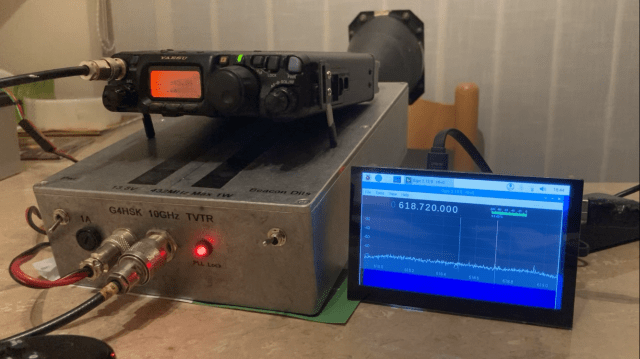
My TVTR receive lineup uses an LNB frontend into a downconverter. The output from the LNB (618MHz) is split between the downconverter and a port suitable for an SDR unit. So I decided to try a Raspberry Pi (RPi) with a touch display and after some research ordered a RPi 4b with 4GB of memory and a Waveshare 5″ DSI Touch Display. The RPi was configured to run the latest Debian Bookworm OS with desktop UI and GQRX  for the SDR software. I really was not sure how good the display would be, but based on my results so far it’s really great in terms of size, touch usability and display quality. How good it will be outdoors in sunlight remains to be seen.

The photo above shows the initial setup with GQRX configured to display the 10368.00 to 10369.00 segment of the band (618 = 10368MHz). Two signals can be seen on the waterfall, my personal QRPp beacon and GB3PKT beacon on 10368.946. GB3PKT was via RS and 1kHz off frequency due to Doppler shift.

After some further configuration changes within GQRX I now have it showing the actual receive frequency rather than the LNB output frequency.

As the setup works well and the screen size is more than adequate for my intended use the next stage will be to shoehorn all the hardware into a 160mm x 103mm x 53mm Hammond 1455 series aluminium enclosure. I’m confident that the enclosure will accommodate all the parts, the challenge is going to be the interconnecting cables etc. especially the USB ones. My aim is to have minimal external connectivity, ideally it will be just power, RF input and one USB port for optional devices such as mouse / keyboard / alternative SDR device.

Not having access to a fully equipped workshop means that the metal-bashing side of any project tends to be my least favourite part… so more to follow on this, but first I need to explore ways to start and safely shutdown my new panadapter using a button / toggle switch. 🙂


Posted in 3cms, Blog, GHz_Bands, Mobile / portable Operation, Raspberry_Pi, SDR | Leave a comment

Fun on 10GHz – First 12 Months of EME Operation

Inspired by various articles written by VK7MO, G3WDG, GW4DGU and others I wanted to see what I could achieve using just a 1.2m off-set dish and 10 – 12W RF at the feed point.

I had my first 1st 10GHz EME contact in August 2023. It’s now December 2024 so you’re possibly thinking that’s far longer than a year! Yes, you’re correct, but in terms of my actual EME operation I’ve only had the gear on the dish for 12 Moon cycles or less. 🙂

During this time the setup on the dish has undergone a number of small upgrades to optimise the transmit side of things. This work, plus concerns over potential damage from condensation within the enclosure, has meant that the gear was not mounted on the dish for several months, especially when the weather was wet and cold. As I type this, the gear is again off the dish in preparation for work to improve the PA cooling in the summer months!

My current setup consists of:

At the Dish:

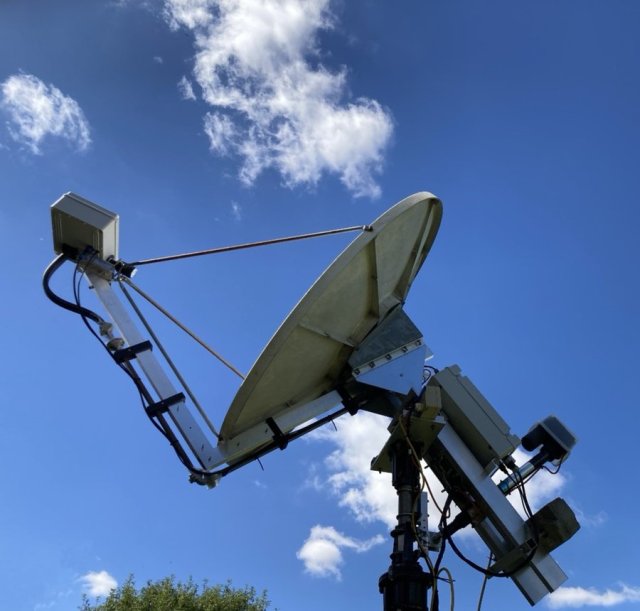
  • 1.2m EchoStar fibre-glass OS dish
  • W2IMU feed horn
  • DU3T WG XLNA
  • WG16 WG switch
  • Kuhne MKU G4 Pro transverter (144MHz IF)
  • MAL 10-12W PA
  • Sequencer
  • ESP32 WiFi server for reporting operating temperatures, RF input / output etc
  • SuperJack QUARL actuator for elevation.
  • Yeasu G-650C for azimuth(!)

In the Shack:

  • Anglian transverter (28MHz IF)
  • K3 for WSJT-X
  • FCDPP (in parallel with K3) + LINRAD for QMAP
  • Noise Meter (in parallel with FCDPP)
  • K3NG and PstRotator for AZ/EL control.

Results so far:

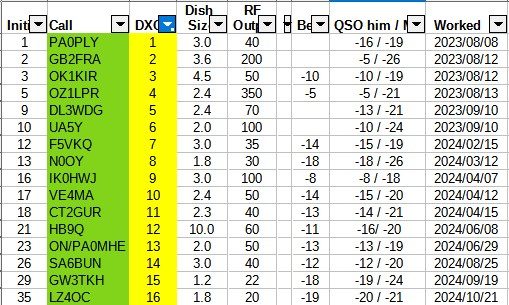
Currently 35 Initials worked and 16 DXCC.

You might expect all of my QSO partners to have been using large dish setups, i.e. at least 2.4m or bigger and QRO. That’s not the case at all as can be seen in the table below.  More small dish stations are becoming active with optimised 1.0 -1.5m dish installations, now when conditions are good it’s not uncommon to see them completing successfully with stations using a 1.8m dish or smaller.

The table below shows where I have completed with QSO partners using a 1.8m dish or smaller.

It took many attempts to complete my first 1.2m to 1.2m dish QSO. Thanks to Keith, Gw3TKH patience and a period of favourable conditions we finally made it. The contact took just over twenty minutes to complete and I was extremely happy. Not only was this my smallest station worked so far, and an Initial contact, but also a new DXCC!

My second 1.2m to 1.2m dish contact one month later with Eric, ON4CDU completed almost text book style, had I not have accidently repeated one period we would have completed without needing any duplicate messages or averaging.

Almost 50% of my Initial contacts have been new a DXCC. The following table shows the results so far:


Lessons Learnt:

  • Every 0.1dB loss or gain counts, nothing new maybe, but it’s even more so on the microwave bands.
  • Dish profile with optimised feed at the correct focal point are all key to good results.
  • Dish accuracy in terms of aiming and tracking is very important. My manual tracking, only during receive periods, is not ideal and I expect it accounts for my received signal being potentially a dB or so down on what it could be.
  • Having the ability to peak the dish on Moon / Sun noise is extremely useful and is key to my results so far.
  • Doppler shift can be more than 20kHz on 10GHz so you really do need a rig that can be CAT controlled to automatically adjust the frequency on both RX and ideally TX. Unfortunately very few rigs allow frequency changes during TX, this includes the K3.
  • Fog and rain can add additional attenuation making things even more of a challenge, especially at low elevation angles.
  • Given minimum elevation and azimuth constraints, activity levels, and un-friendly night time operation all can equate to just a few days or even hours of operation a month.
  • Currently my PA, including heatsink is inside the outdoor enclosure. A small fan forces airflow through the enclosure via two 40mm diameter inlet / outlets. This is inadequate for extended periods of operation during the summer months.
  • If you have a good terrestrial 10GHz setup, adding elevation could enable you to try EME.

Things are quite different compared to my time spent on 2m EME. Activity levels vary enormously. The 10GHz EME Directory maintained by PA0PLY lists around 200 or more active stations yet aside from contests or DXpeditions activity is unfortunately fairly low at other times. A new station invariably generates more activity. On a positive note, there have been several new small dish stations active recently so that bodes well for the future. The majority of my contacts so far have been “random” i.e. not pre-arranged / announced, but simply in response to me calling the station. I guess this has always been my preferred way of EME operation. I’m sure had I been more active on EME Chat I could have increased my count of initials worked. The same applies to my operating times, I now find it a real struggle to operate through the night and so tend to be only QRV at more sociable hours.  🙂

What’s next:

  • Improve the dish rotator setup.
  • Improve PA cooling.
  • Improve safeguards against condensation.
  • Investigate ways to be able to receive the 10450 – 10452MHz segment and work JA.
  • When the 10GHz EME gear is off the dish I replace it with my QO-100 setup. I will be looking to see what a can decode off the Moon with this when I’m not QRV on the transponder. It’s certainly possible… See here.
  • Share information to try and encourage more people to experiment on the uW bands.


Posted in 3cms, Blog, EME, GHz_Bands | Leave a comment

Fun on 10GHz – Decoding DL0SHF beacon using QO-100 system

Having been away from home for a while I was keen to “get back on the radio”. EME conditions were looking good, degradation very low, Moon near Perigee and Moon pass times good, i.e. not in the middle of the night. Unfortunately I’d taken all the EME gear off the dish in preparation for a winter overhaul prior to my trip so all I had installed on the dish was the feed for my QO-100 system.

For those of you unfamiliar with EME operation, there tends to be a number of variables occurring during a receive / transmit period, in particular at the higher microwave frequencies. Two key ones are, not only is the Moon position changing in both AZ / EL, the signal being received is also changing frequency due to Doppler shift. Both of these are going to influence getting a successful decode and the optimum signal strength. My 10GHz EME system is configured to minimise the effect of these, a noise meter enables me to ensure that the dish heading is optimised and the WSJT-X software is able to automatically change the receive / transmit frequencies via CAT control.

I’d copied the DL0SHF beacon in the past using a modified LNB but never tried with the current QO-100 feed setup where the 2.4GHz helical feed sits on the front of the LNB. This arrangement can have a detrimental effect on the LNB receive performance. Something I’ve not quantified or really considered as an issue when used with the QO-100 transponder. Whereas with EME every 0.1dB counts.

To receive the beacon (on 10368.024 MHz) using the LNB I would need to use SDRConsole (or similar) tuned to the output of the LNB around 618.024MHz and pipe the audio output from SDRConsole into WSJT-X using VAC (Virtual Audio Cable)

Whilst my AZ/EL rotator setup is capable of finding the Moon and tracking it, it is not optimised to track in 0.1 degree increments and received signals are typically several dB down compared to when the dish is manually peaked on Moon noise.

I was fairly confident that I would get some form of decode, but without Doppler correction and Moon noise alignment just how well would the beacon be decoded?

I used the Doppler correction display from WSJT-X to determine the frequency I needed to tune SDRConsole to and looked carefully at the waterfall hoping to see some form of trace. A few nudges of the AZ/EL controls and the beacon was showing on the waterfall. The WSJT-X Doppler screen showed that the beacon received frequency was moving LF by about 1Hz a second. I manually adjusted the SDRConsole frequency at this rate and nudged the dish position to maintain the brightest trace on the waterfall. The results were surprising!

I was able decode the beacon at best -7dB, this was within 1dB of my best ever decode using my optimised W2IMU feed and DU3T WG LNA. It was unfortunate that I could not do a real-time side by side comparison of decoded signals to see how the two receive systems compared.

SDRConsole now has the ability to measure Sun / Moon noise when running in Continuum Mode. Whilst this is not the best time of the year to do Sun Noise measurements it will be interesting to see what results I can get and how they compare to those calculated by VK3UM (SK) EMECalc software.

This proved to be an interesting test and once again showed how a simply modified LNB can form a very good receive setup for the 10GHz amateur band. You can find an example / additional information here.

Posted in 3cms, Blog, EME, GHz_Bands, QO-100, Satellites | Leave a comment

Fun on 10GHz – Rain Scatter 2024-07-15

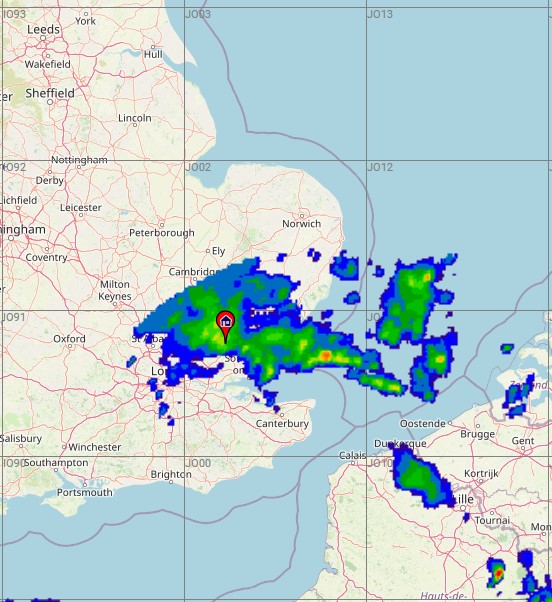
Summer 2024 has been pretty poor so far weather wise, in summary it’s been pretty wet! On the 15th July we had some very heavy bursts of rain with lots of nearby rain cells as shown in the photo above.

This gave another opportunity to see what could be heard / seen using a small indoor 10GHz setup. With the horn antenna pointing out through a downstairs window there is really no clear take-off to the horizon, so these local rain cells were ideal allowing me to point the antenna up at angles of 35 degrees or more thereby looking out over the nearby trees and buildings.

The indoor setup, showing the transverter (TVTR), FT-818 and 20dB gain horn antenna. Not shown is the laptop and SDR that runs in parallel using the 618MHz output from the TVTR.

As the rain cells moved towards the East the usual Doppler shift could be seen and heard on GB3PKT, my nearest 10GHz beacon, it was peaking S9 at times with the antenna pointing way off the boresight.

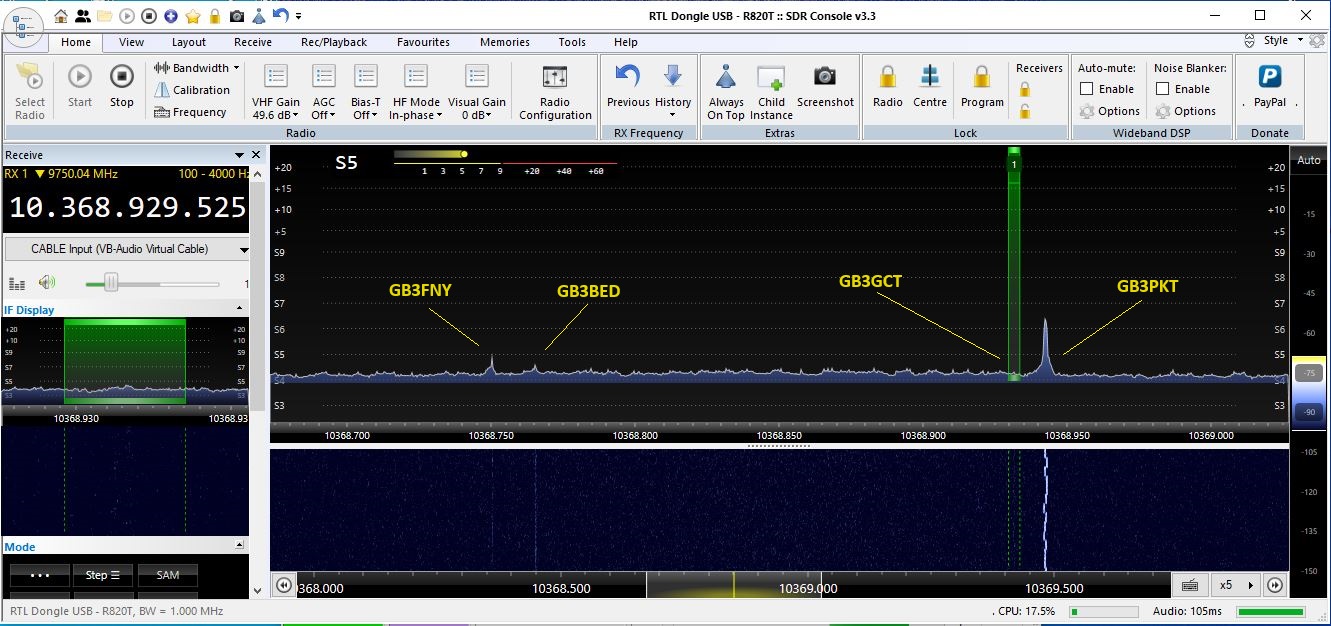
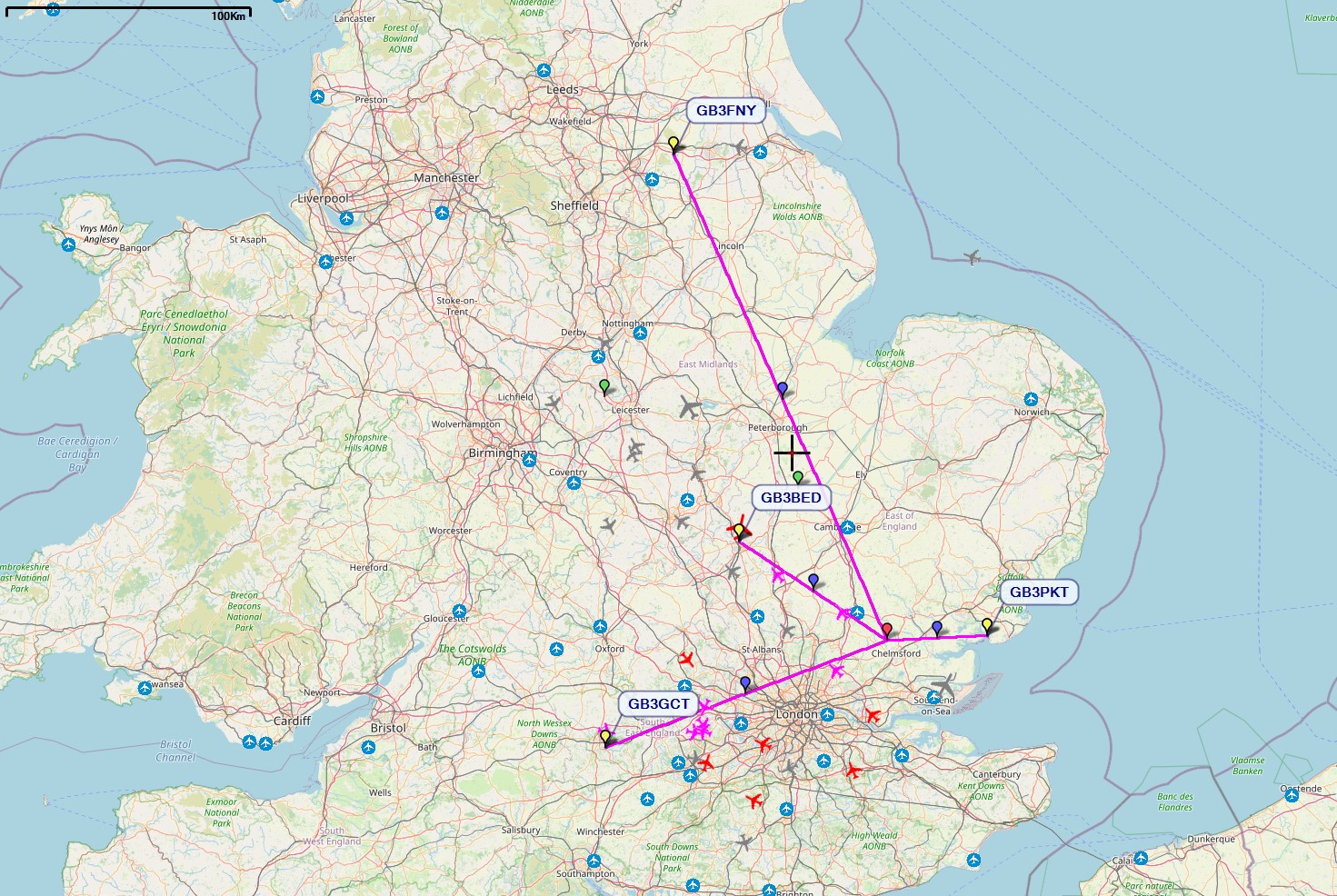
In addition to GB3PKT two other beacons appeared on the waterfall, GB3BED in Bedford and GB3GCT in Newbury. GB3GCT was a new one from the home QTH. A short time after a new trace appeared on the waterfall and slowly increased in strength. This turned out to be GB3FNY in Finningley, Yorkshire over 200km away.

With the antenna position optimised on the cell I was able to see all four beacons together on the waterfall as shown above.

For those that may not know where these beacons / places are located in the UK the photo below shows their positions in relation to my home QTH.

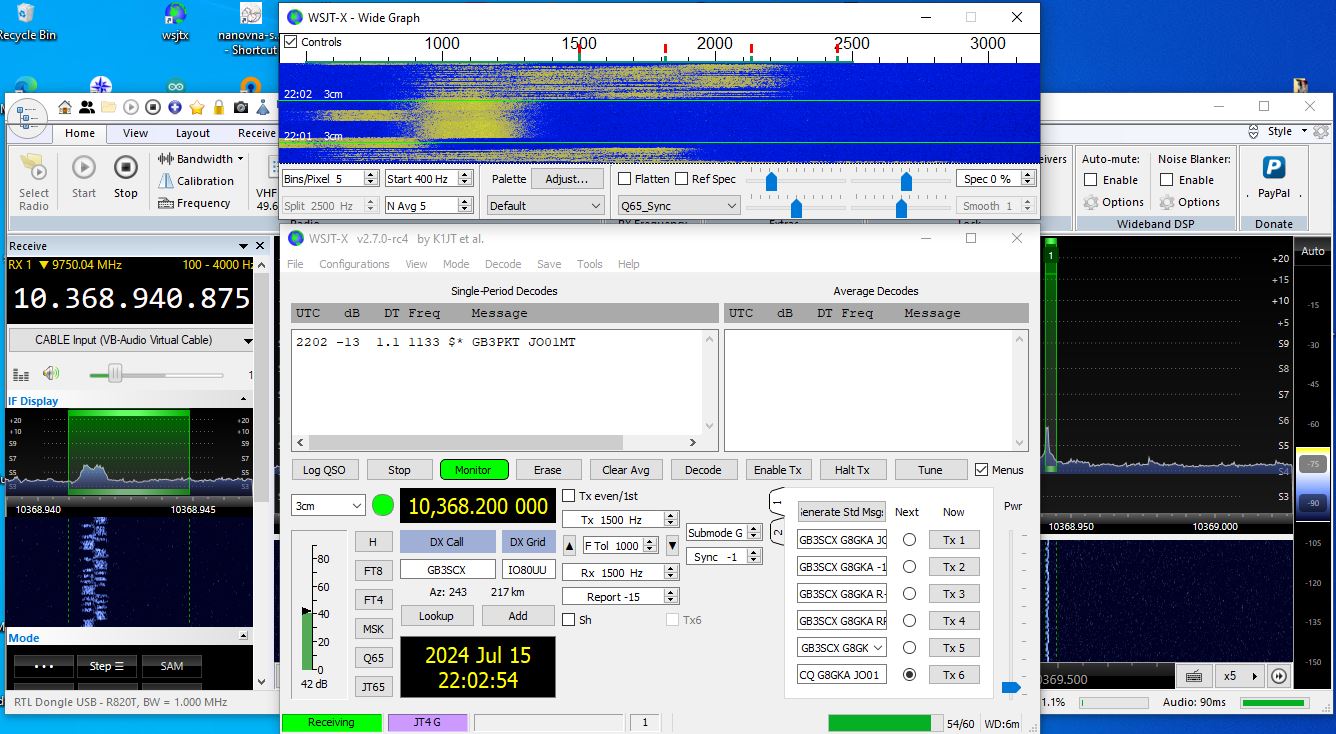
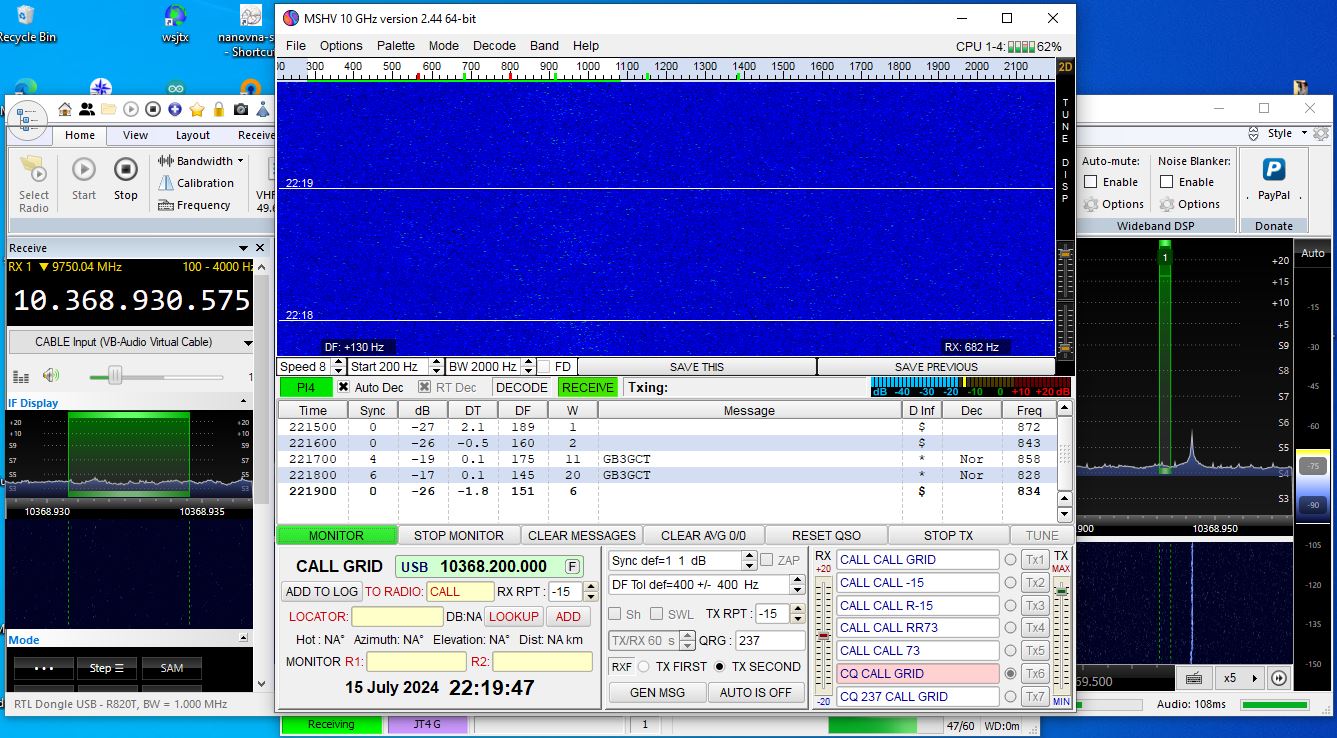
With the received audio piped from SDRConsole to WSJT-X / MSHV  using virtual audio cable software I was able to decode the two MGM enabled beacons.

GB3PKT running JT4G

GB3GCT running PI4

Currently the SDR I’m using for these tests is not ref-locked and there’s no CAT connection between the laptop and FT-818. The next thing is to implement both which will help when looking for weak traces and measuring the effects of Doppler on a signal. My 10GHz operation is still very much WIP.   🙂


Posted in 3cms, Blog, GHz_Bands, SDR | Leave a comment