
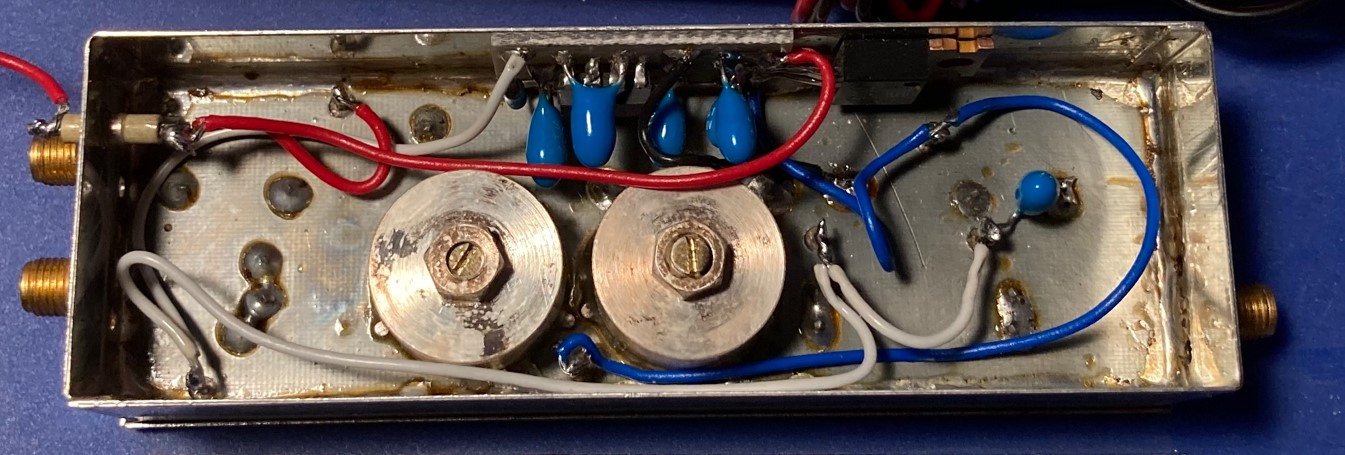
I recently finished building the G3WDG-002 receive converter, a project that I started around 30 years ago! At that time I purchased the G4DDK-004 LO and the G3WDG-002 kits to get started on 10GHz narrow band modes (SSB, CW).
The G4DDK-004 module was completed, aligned and fully working (dated June ’96, as shown in one of the photos below). There was a small group of us building the G3WDG Transverter. One of the group was living very close to me and we were both working together to get our receive converters working. Sadly he became ill and went SK before we completed them. As a result, my partly built kit sat in a box untouched until last year when another of our group sadly went SK! He and I had been reminiscing and we had talked about these modules and how he had aligned and measured the output of my LO kit. It was then I decided that I really should finish what we had started together all those years ago.
Whilst I still had the box of parts and a partially completed converter I was missing the build documentation. Fortunately a quick online search resolved that issue and I found all I needed here… thank you Dave. Checking the parts list I found that I was missing the 2K2 preset pots and I didn’t have the required Birkett red or black spot GaAs FETs. Fortunately I did have the mixer diode and a packaged strip of 10 NEC NE32184A GaAs FET devices. I guess someone at the time, with far better knowledge than me, decided that these were a good option.
The part built receive converter:
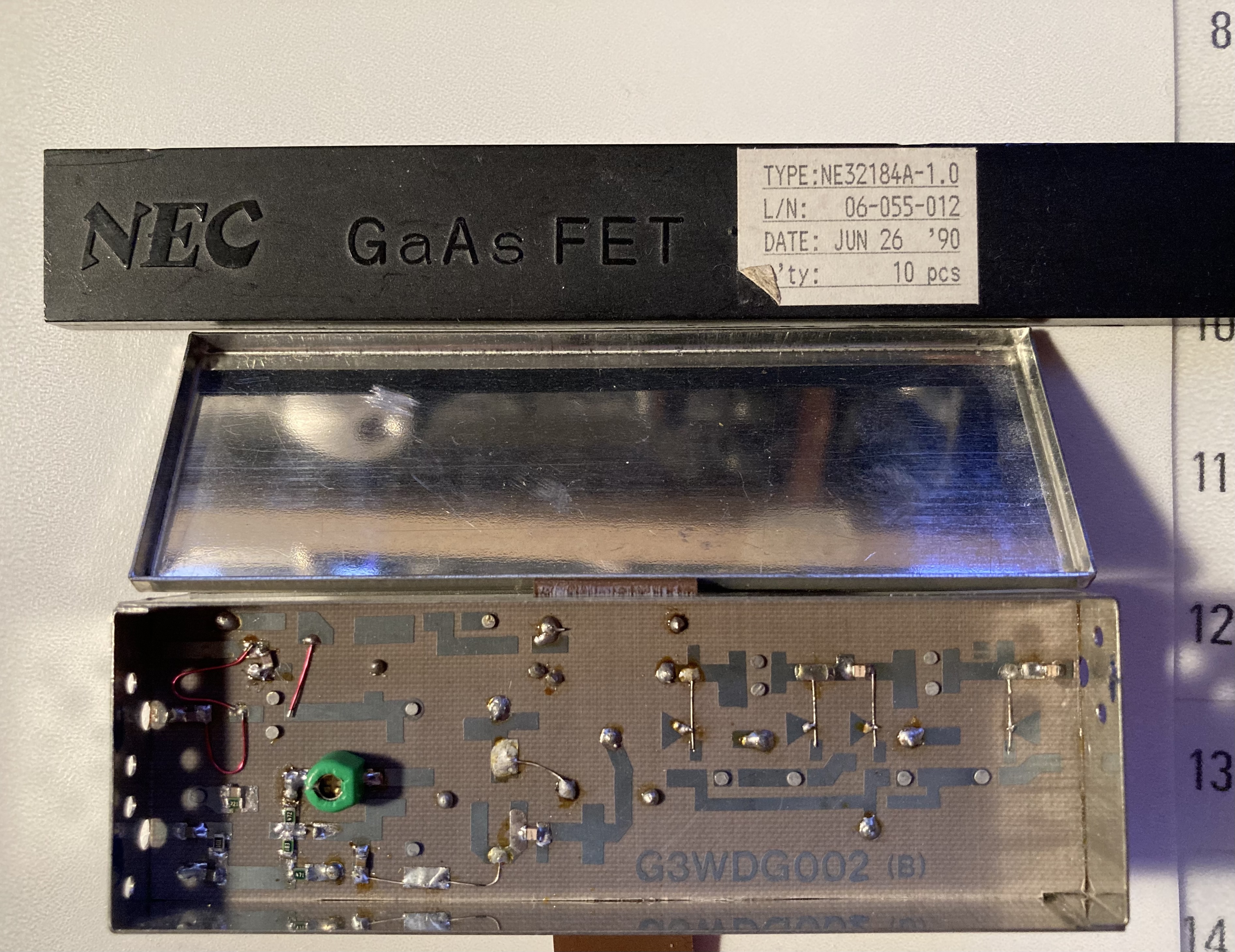 Surprisingly the board and tin box enclosure were in very good condition as were the filters mounted on the opposite side of the PCB. The PCB tracks were all tarnished and needed to be carefully cleaned with a glass-fibre pen. Once this was done, I soon picked up from where things had been left off all those years ago, and continued on, following the excellent build instructions. It all went together without any issues.
The documentation warned against part substitutions, so the use of different FETs was a bit of an unknown. I used the G4DDK-004 LO and followed the alignment instructions. Each alignment step resulted in what was expected and I could receive my personal 10GHz beacon.
Here’s the completed module:
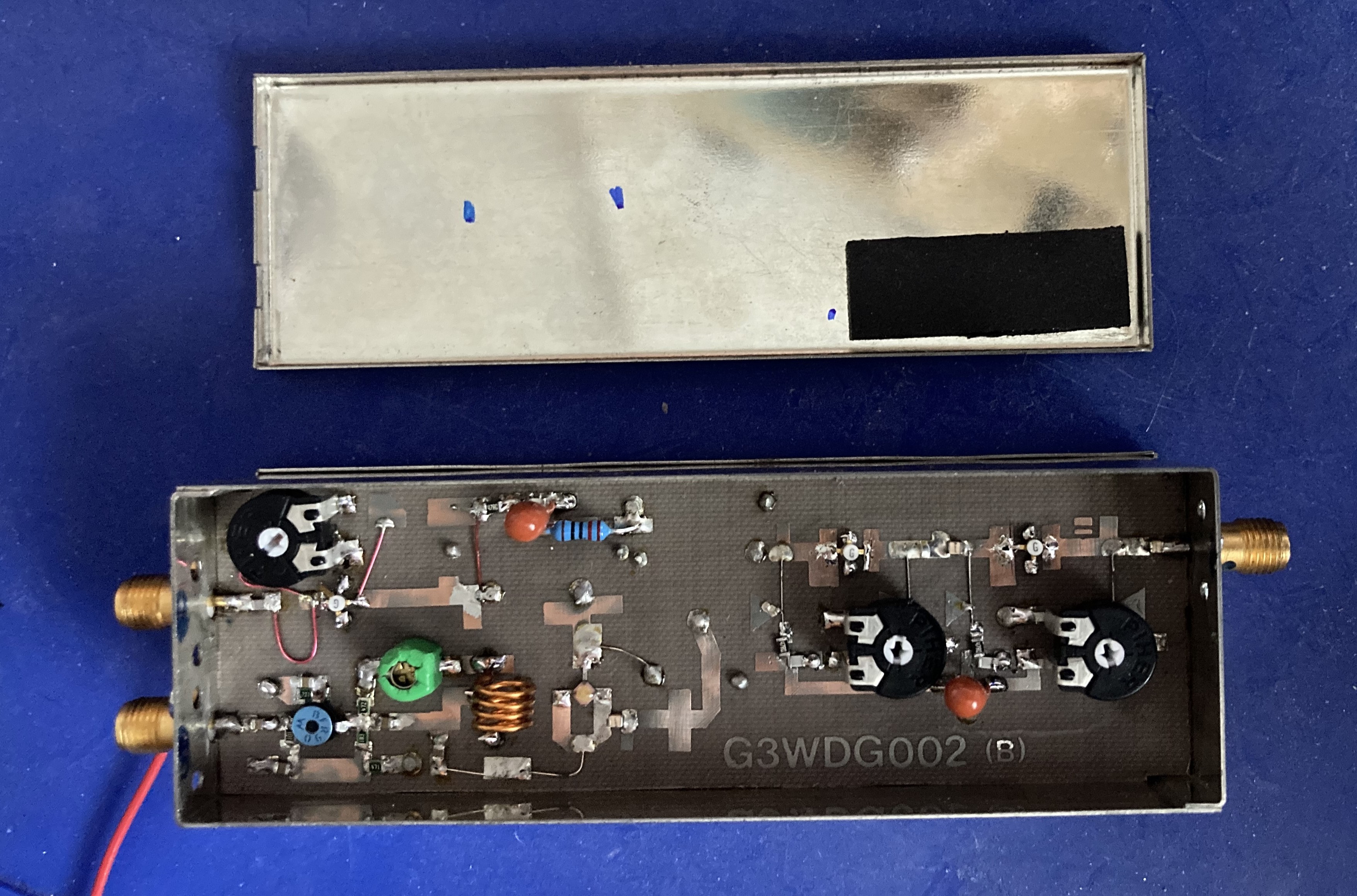 The NE32184A devices worked fine, a small piece of RAM was needed on the underside of the lid to stop some oscillation when the lid was fitted, but that was documented in the assembly / alignment notes and fully resolved the issue.
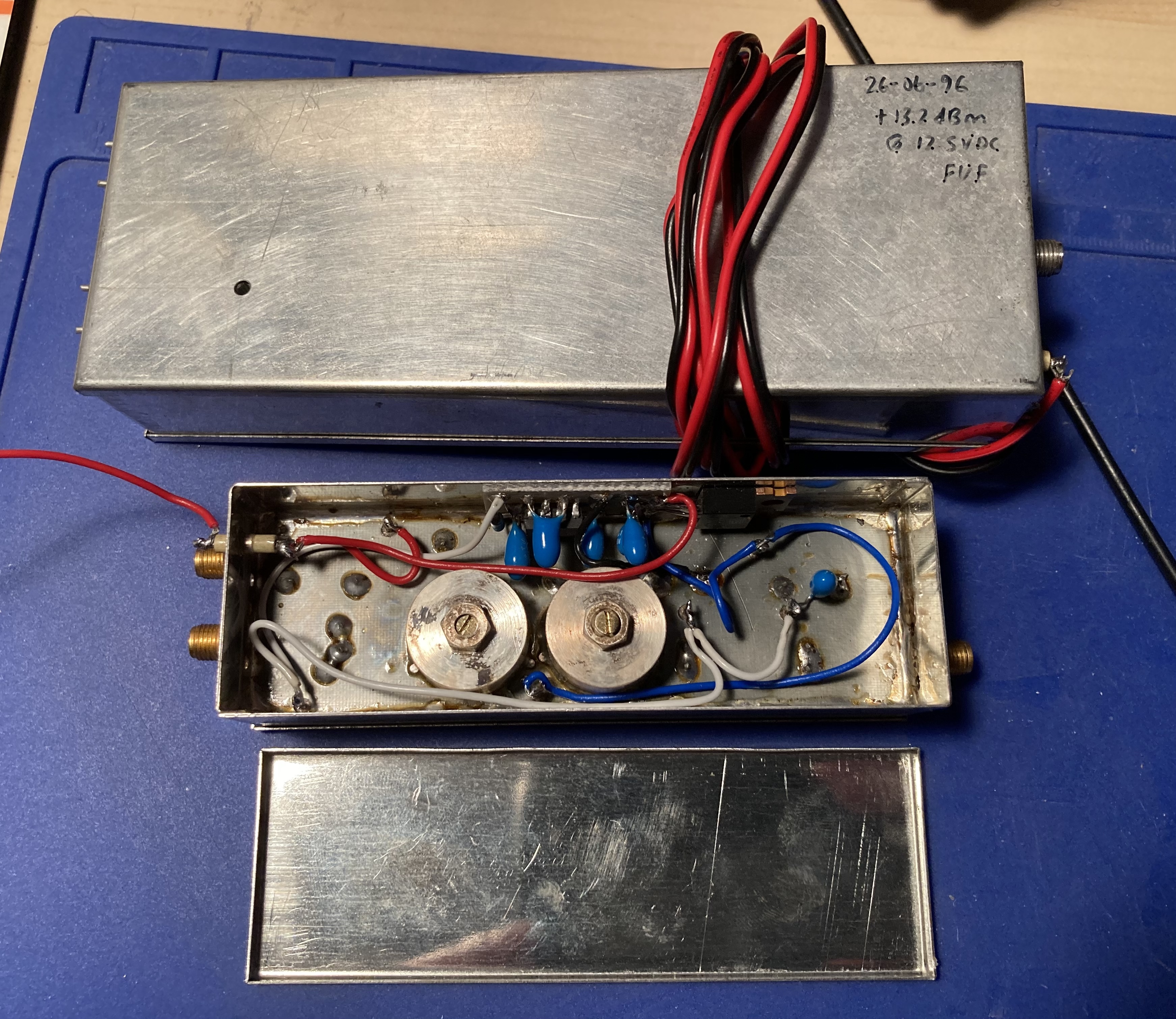 The photo above shows the G4DDK-004 module which produces the 2256MHz LO needed for the receive module. The 2556MHz being derived from a 106.500MHz crystal fitted with a Murata posistor crystal heater. I modified this unit for injection locking using an ADF4351 SynthShield and 10MHz GPSDO reference. This is working very well.
As the ADF4351 is capable of generating 2556MHz itself, I’m currently experimenting with an alternative LO setup. Tests so far are proving to be good. The LO output level is much lower with the ADF4351 (+3dBm compared to +13dBm) so further tests are needed to see if a small amplifier will be needed.
The new LO setup can be seen in the photo below:
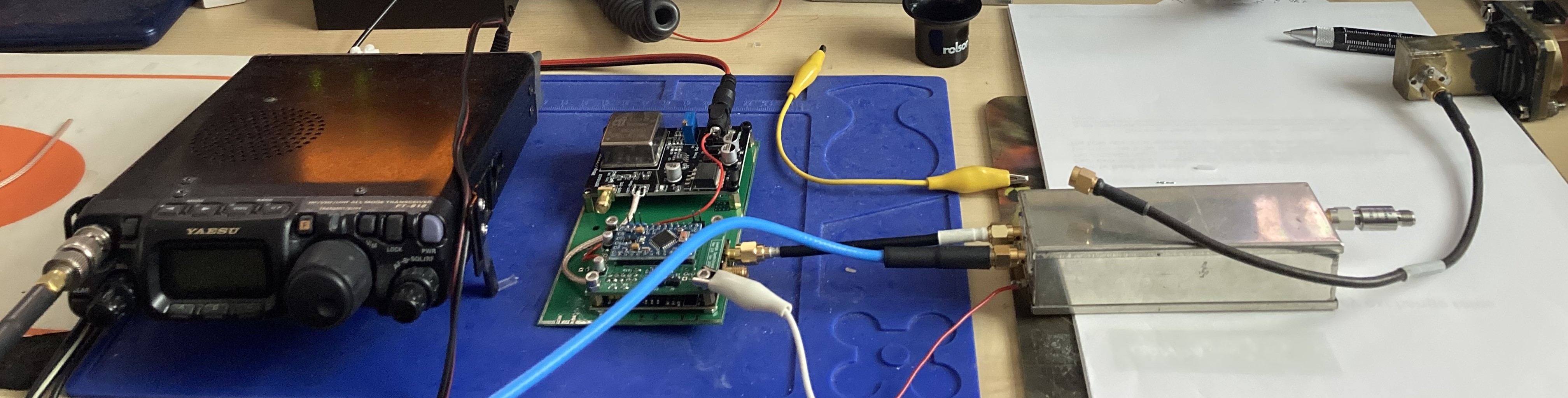
 Once this new LO is put in an enclosure I will add an SMA input socket and power switching so that the ADF4351 SynthShield can work with either an external 10MHz GPSDO reference or the internal 10MHz OCXO.
So far testing has been rather limited but all the indications suggest this receive converter is working well. It will be very interesting to compare it against the typical setups in use today. I’m particularly keen to see how it compares with my modular 10GHz /P TVTR.
 G4HSK
G4HSK 