
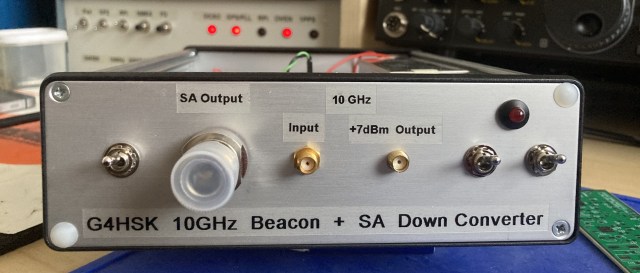
 This project is the result of wanting:
- A small easy to handle, self contained, frequency accurate 10GHz test source that ccould be used for such things as dish / RX alignment, used as an RF source in conjunction with a power meter for measuring cable loss, filter alignment etc.
- A QRP 10GHz beacon with CW ID that could be used for longer distance / term tests.
- A quick and easy means of using my existing Rigol DSA815TG Spectrum Analyser (that’s limited to 1.5GHz) to do some basic signal / spectrum analysis at 10GHz .
I could already do some of what I wanted by making use of an existing 10GHz TVTR as the RF source and a spare LNB for the down converter but it meant that I had to bring various things back into the shack, that then also needed 144MHz IF, a 10MHz reference and power just to do simple cable measurements! The LNB also needed a Bias-T, 12V power and wasn’t ref-locked. A lot of messing about…
The solution was to combine some of the modules that I had used in previous projects to produce a self-contained unit that needed just 12V power.
The photo below shows all the modules in place (taken prior to adding all the inter-connect cables etc.)
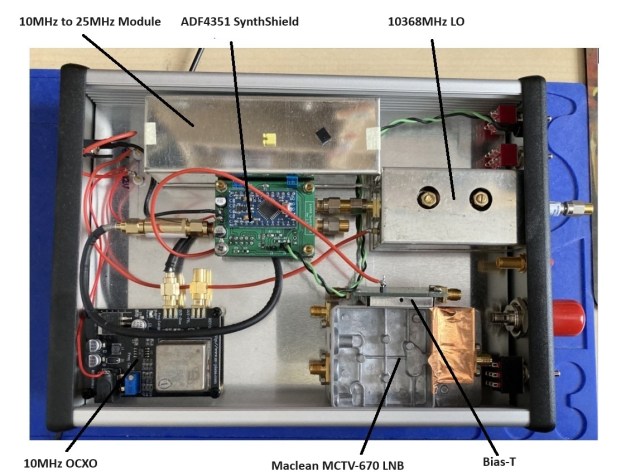
The six modules are as follows:
10MHz OCXO Module
This low cost 10MHz OCXO forms the heart of this project. Once checked and adjusted for exactly 10MHz output they prove to work very well. The one used here did require a slight modification to get it exactly on frequency. More information can be found online by doing a simple search for “10MHz OCXO frequency standard”. One 10MHz port is used to ref-lock the “ADF4351 SynthShield” module, the second 10MHz port is used by the “10MHz to 25MHz source” module.
ADF4351 SynthShield” Module
For this application it is configured to produce output at either (a) 3456.020MHz or (b) 3456.240MHz. The Arduino sketch will provide either a continuous RF carrier with a 2 second break every 35 seconds on frequency (a) or on frequency (B) a “VVV G4HSK/B JO01fs” CW beacon Ident followed by a 35 scond carrier repeated approximately every 60 seconds. As a GPS is not being used timings are dependent on the Arduino onboard clock. More detail on this module can be found here.
10368MHz LO Module
This module muliplies the 3456MHz output from the ADF4351 SynthShield Module and produces +7dBm output at 10368MHz. This is the second LO board I have built and it has proven that it’s a reproducable signal source for 10GHz. More detail on this module can be found here.
10MHz to 25MHz Source Module
This module filters the 10MHz from the OCXO, divides the filtered 10MHz by 2 using a 74HC390 to produce 5MHz, the 5th harmonic (25MHz ) is then filtered through a 4-pole Xtal ladder filter followed by a MIMIC amplifier stage. The 25MHz output from this module is used to ref-lock the Maclean MCTV-670 LNB module.
Maclean MCTV-670 LNB Module
I have now used this relatively low cost LNB in a number of projects. It’s easily modified to produce a compact module with SMA connections. The ref-locked output from the LNB (618MHz = 10368MHz) is ideal for my Rigol SA and allows me to get some basic idea of whats happening several hundred MHz either side of 10368MHz. More details about modifying the LNB can be found here.
Bias-T Module
This uses a small general purpose “MIMIC / Attenuator / Bias-T board” PCB that I had made and is used to provide 12V power to the LNA via its RF ouput SMA connection.
Project Outcome
The beacon / RF signal source works exactly as I had intended. Output is +7dBm which when used with a 6dB attenuator I find to be a nice level for measuring cable loss etc.
The Arduino sketch used on the Arduino / SynthShield is a derivative of the beacon project shared here by IZ1MLT. I modified the original sketch to support either one of two frequencies that can be selected by a jumper / switch on the SynthShield, control a ref-lock LED indicator and to provide either a continuous RF carrier or a beacon with CW-Ident. Once the OCXO has warmed up and settled, the frequency stability and accuracy at 10GHz signal is impressive.
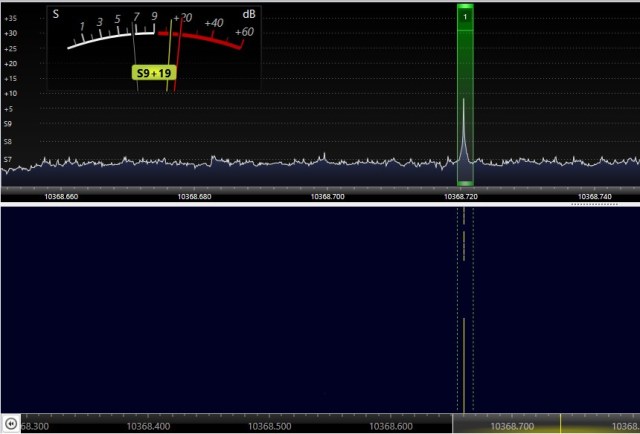
The following photo shows the beacon being received on 10368.720MHz It’s just transitioned from carrier to the start of the CW. The first “V” ( … _ ) of the “VVV G4HSK/B JO01fs” CW Ident can be seen.
The SA Down Converter works as expected. The screen grab below shows a test signal from the 10GHz beacon on the Rigol DSA815-TG.
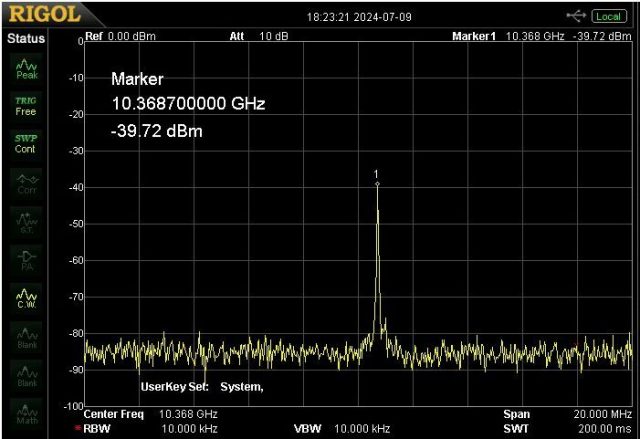
Calibration with a known source is necessary to get some idea of power measurement. However when used for basic spectrum analysis and tuning for maximum gain it works fine. If used with an SDR this module can also serve as a spare 10GHz or QO-100 receiver. Care needs to be taken to attenuate signal levels both on the input to and output from the LNB module. An LNB can have so much gain there is the potential to do damage. I have an attenuator permanently on the output port of the LNB inside the enclosure.
All the above modules were fitted into a Hammond extruded aluminium enclosure. These have now become my favourite type of enclosure for indoor projects. The Aluminium end-plates are easy to work with and the removeable sliding top / bottom panel make for easy assembly. As an added bonus it’s possible to use your favourite PCB manufacture to produce replacement coloured end-panels, all drilled and with silk-screen printed lettering.
Acknowledgements:
- IZ1MLT for his CW Beacon sketch.
 G4HSK
G4HSK 