

I have been testing the noise meter modules with them connected to the 144MHz IF output of my 10GHz transverter. To make best use of the noise meter when working in the shack it ideally should work at 28MHz, i.e. the IF output of the Anglian 2m transverter. This would then enable me to do measurements on 3 bands, i.e. 144MHz, 1296MHz and 10368MHz. To do this another frontend IF Amplifier module is needed but this time it should be optimised for 28MHz. Fortunately the same PCB could be used, the only changes being the BPF.
I constructed the BPF first and checked the filter characteristics before adding the three MMIC amplifier stages.
Here’s a screen grab showing the BPF characteristics:

28MHz BPF Characteristics
The gain from this new module is currently “only” +60dB as my parts drawer didn’t have three spare MAR-8A+ devices and so had to use slightly lower gain MMICs.

The photo below shows the 28MHz RF Amplifier Frontend board being tested and the meter showing just under 4dB of Sun noise on 10368MHz (using a 65cms OS dish).

The next step was to house the new frontend board in another “German tin plate box” and put all the parts in a suitable enclosure.
This resulted in more melting of solder, drilling and filing…
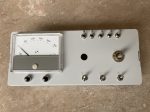

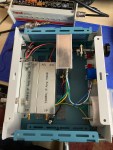


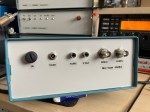

I also added an internal homemade stepped (1dB to 20dB) attenuator made using small toggle switches and SMT resistors.
My Anglian transverter has a 3dB splitter on the IF output, one side goes to the K3 and the other to a FCDPP for use with Linrad + MAP65 or SDR-Console. The FCDPP unit incorporates an antenna c/o relay and switched 13.5V controlled by the RX/TX sequencer to protect the FCDPP on transmit so I added an additional 3dB splitter to provide the 28MHz IF output to both the FCDPP and the noise meter. The splitter being a simple lumped element Wilkinson divider built on a spare RF relay PCB found in my projects drawer.
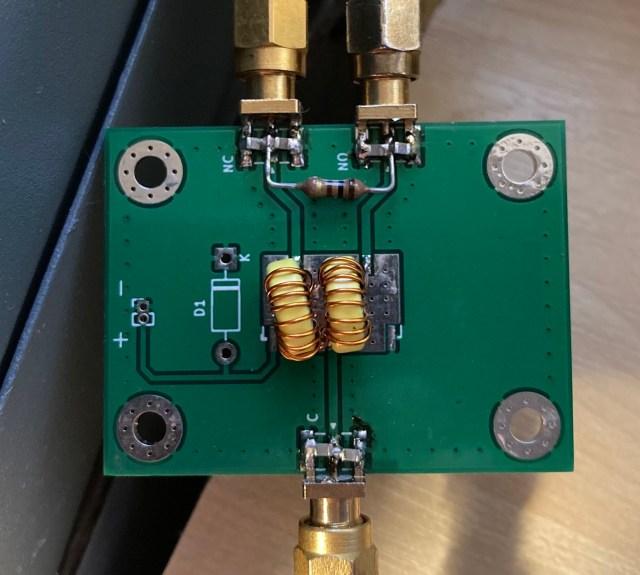
28MHz Splitter
I now have a noise meter that can be used outdoors connected directly to the 144MHz output of the dish mounted transverter(s) or used in the shack connected to the 28MHz output of the Anglian 2m transverter with sequenced transmit / receive switching (protection).
The following diagram outlines the various combinations that the noise meter can be used:

Options for using noise meter
The completed noise meter works well. The large meter makes it very easy to see if the dish is pointing accurately at the Moon or Sun. It can be used in the shack in parallel with Spectravue which is still very useful as you can capture and save the results of your measurements / tests.
I’m sure this new piece of test gear will be put to good use setting up and optimising my new dish setup.
 G4HSK
G4HSK 