
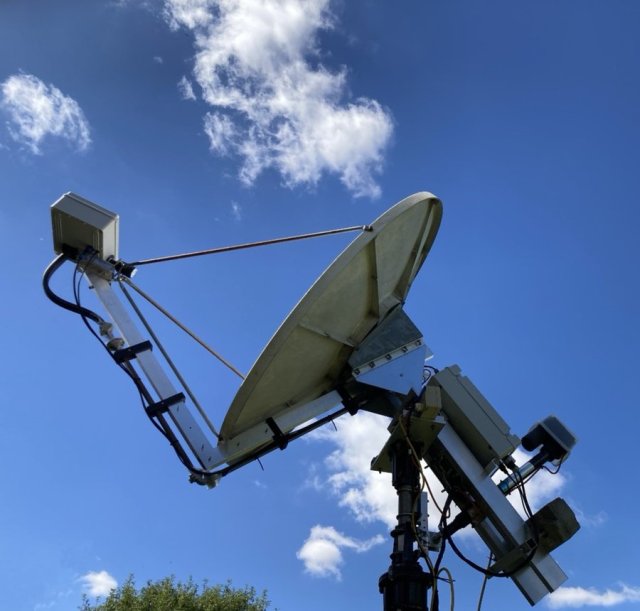
Inspired by various articles written by VK7MO, G3WDG, GW4DGU and others I wanted to see what I could achieve using just a 1.2m off-set dish and 10 – 12W RF at the feed point.
I had my first 1st 10GHz EME contact in August 2023. It’s now December 2024 so you’re possibly thinking that’s far longer than a year! Yes, you’re correct, but in terms of my actual EME operation I’ve only had the gear on the dish for 12 Moon cycles or less. 🙂
During this time the setup on the dish has undergone a number of small upgrades to optimise the transmit side of things. This work, plus concerns over potential damage from condensation within the enclosure, has meant that the gear was not mounted on the dish for several months, especially when the weather was wet and cold. As I type this, the gear is again off the dish in preparation for work to improve the PA cooling in the summer months!
My current setup consists of:
At the Dish:
- 1.2m EchoStar fibre-glass OS dish
- W2IMU feed horn
- DU3T WG XLNA
- WG16 WG switch
- Kuhne MKU G4 Pro transverter (144MHz IF)
- MAL 10-12W PA
- Sequencer
- ESP32 WiFi server for reporting operating temperatures, RF input / output etc
- SuperJack QUARL actuator for elevation.
- Yeasu G-650C for azimuth(!)
In the Shack:
- Anglian transverter (28MHz IF)
- K3 for WSJT-X
- FCDPP (in parallel with K3) + LINRAD for QMAP
- Noise Meter (in parallel with FCDPP)
- K3NG and PstRotator for AZ/EL control.
Results so far:
Currently 35 Initials worked and 16 DXCC.
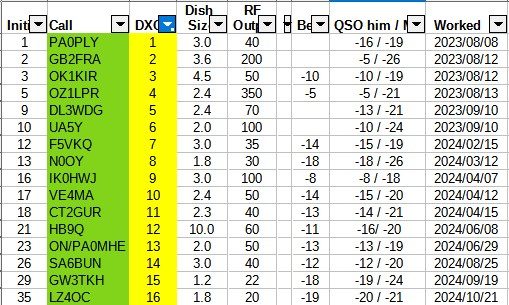
You might expect all of my QSO partners to have been using large dish setups, i.e. at least 2.4m or bigger and QRO. That’s not the case at all as can be seen in the table below. More small dish stations are becoming active with optimised 1.0 -1.5m dish installations, now when conditions are good it’s not uncommon to see them completing successfully with stations using a 1.8m dish or smaller.
The table below shows where I have completed with QSO partners using a 1.8m dish or smaller.

It took many attempts to complete my first 1.2m to 1.2m dish QSO. Thanks to Keith, Gw3TKH patience and a period of favourable conditions we finally made it. The contact took just over twenty minutes to complete and I was extremely happy. Not only was this my smallest station worked so far, and an Initial contact, but also a new DXCC!
My second 1.2m to 1.2m dish contact one month later with Eric, ON4CDU completed almost text book style, had I not have accidently repeated one period we would have completed without needing any duplicate messages or averaging.
Almost 50% of my Initial contacts have been new a DXCC. The following table shows the results so far:
Lessons Learnt:
- Every 0.1dB loss or gain counts, nothing new maybe, but it’s even more so on the microwave bands.
- Dish profile with optimised feed at the correct focal point are all key to good results.
- Dish accuracy in terms of aiming and tracking is very important. My manual tracking, only during receive periods, is not ideal and I expect it accounts for my received signal being potentially a dB or so down on what it could be.
- Having the ability to peak the dish on Moon / Sun noise is extremely useful and is key to my results so far.
- Doppler shift can be more than 20kHz on 10GHz so you really do need a rig that can be CAT controlled to automatically adjust the frequency on both RX and ideally TX. Unfortunately very few rigs allow frequency changes during TX, this includes the K3.
- Fog and rain can add additional attenuation making things even more of a challenge, especially at low elevation angles.
- Given minimum elevation and azimuth constraints, activity levels, and un-friendly night time operation all can equate to just a few days or even hours of operation a month.
- Currently my PA, including heatsink is inside the outdoor enclosure. A small fan forces airflow through the enclosure via two 40mm diameter inlet / outlets. This is inadequate for extended periods of operation during the summer months.
- If you have a good terrestrial 10GHz setup, adding elevation could enable you to try EME.
Things are quite different compared to my time spent on 2m EME. Activity levels vary enormously. The 10GHz EME Directory maintained by PA0PLY lists around 200 or more active stations yet aside from contests or DXpeditions activity is unfortunately fairly low at other times. A new station invariably generates more activity. On a positive note, there have been several new small dish stations active recently so that bodes well for the future. The majority of my contacts so far have been “random” i.e. not pre-arranged / announced, but simply in response to me calling the station. I guess this has always been my preferred way of EME operation. I’m sure had I been more active on EME Chat I could have increased my count of initials worked. The same applies to my operating times, I now find it a real struggle to operate through the night and so tend to be only QRV at more sociable hours. 🙂
What’s next:
- Improve the dish rotator setup.
- Improve PA cooling.
- Improve safeguards against condensation.
- Investigate ways to be able to receive the 10450 – 10452MHz segment and work JA.
- When the 10GHz EME gear is off the dish I replace it with my QO-100 setup. I will be looking to see what a can decode off the Moon with this when I’m not QRV on the transponder. It’s certainly possible… See here.
- Share information to try and encourage more people to experiment on the uW bands.
 G4HSK
G4HSK 