
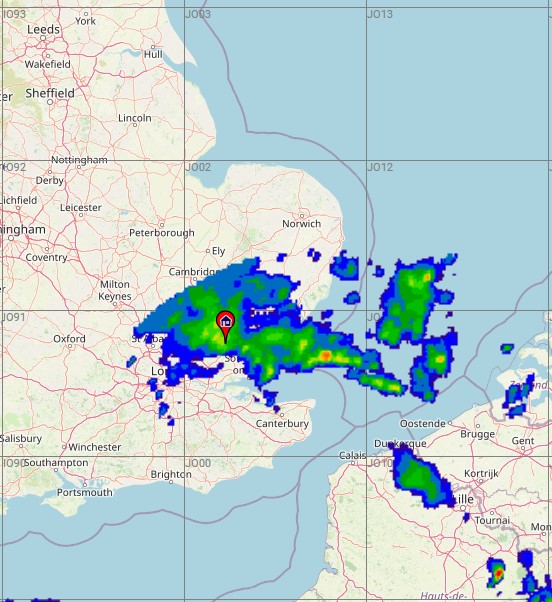
Summer 2024 has been pretty poor so far weather wise, in summary it’s been pretty wet! On the 15th July we had some very heavy bursts of rain with lots of nearby rain cells as shown in the photo above.
This gave another opportunity to see what could be heard / seen using a small indoor 10GHz setup. With the horn antenna pointing out through a downstairs window there is really no clear take-off to the horizon, so these local rain cells were ideal allowing me to point the antenna up at angles of 35 degrees or more thereby looking out over the nearby trees and buildings.

The indoor setup, showing the transverter (TVTR), FT-818 and 20dB gain horn antenna. Not shown is the laptop and SDR that runs in parallel using the 618MHz output from the TVTR.
As the rain cells moved towards the East the usual Doppler shift could be seen and heard on GB3PKT, my nearest 10GHz beacon, it was peaking S9 at times with the antenna pointing way off the boresight.
In addition to GB3PKT two other beacons appeared on the waterfall, GB3BED in Bedford and GB3GCT in Newbury. GB3GCT was a new one from the home QTH. A short time after a new trace appeared on the waterfall and slowly increased in strength. This turned out to be GB3FNY in Finningley, Yorkshire over 200km away.
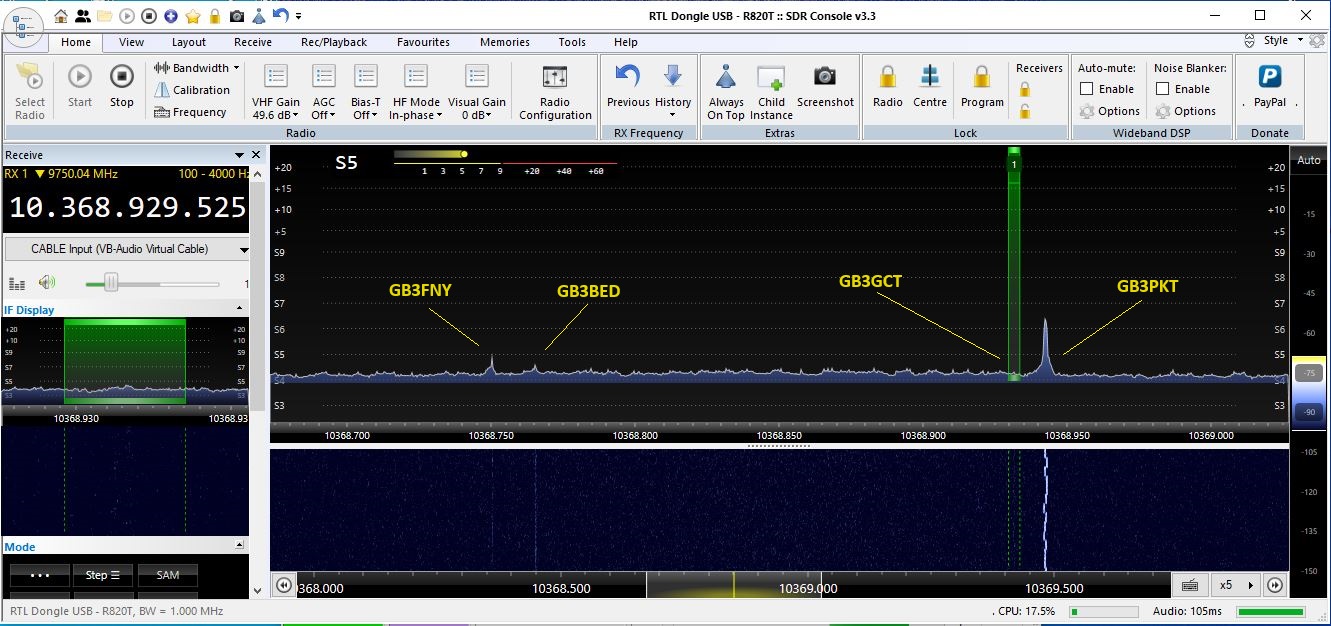 With the antenna position optimised on the cell I was able to see all four beacons together on the waterfall as shown above.
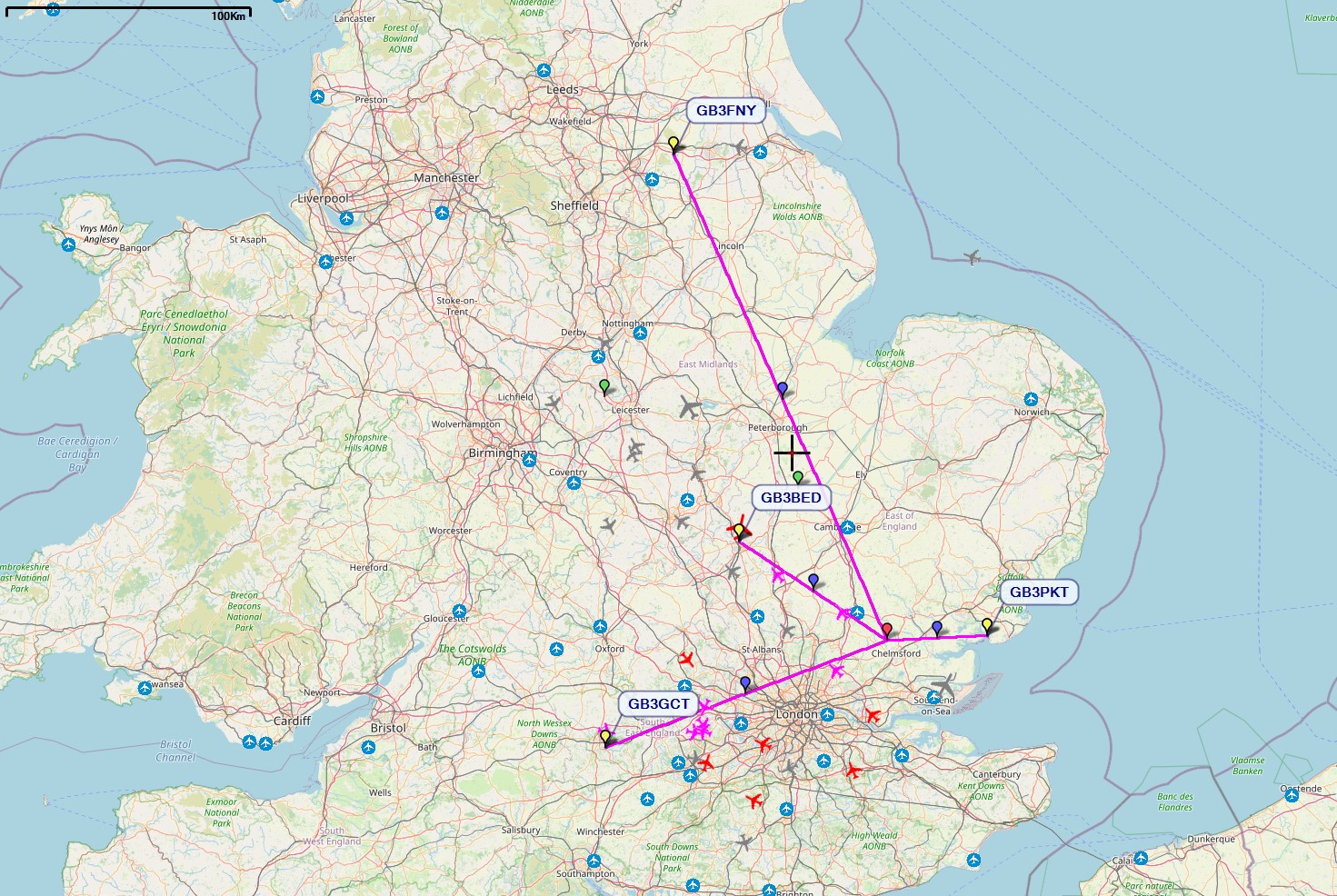
For those that may not know where these beacons / places are located in the UK the photo below shows their positions in relation to my home QTH.
With the received audio piped from SDRConsole to WSJT-X / MSHV using virtual audio cable software I was able to decode the two MGM enabled beacons.
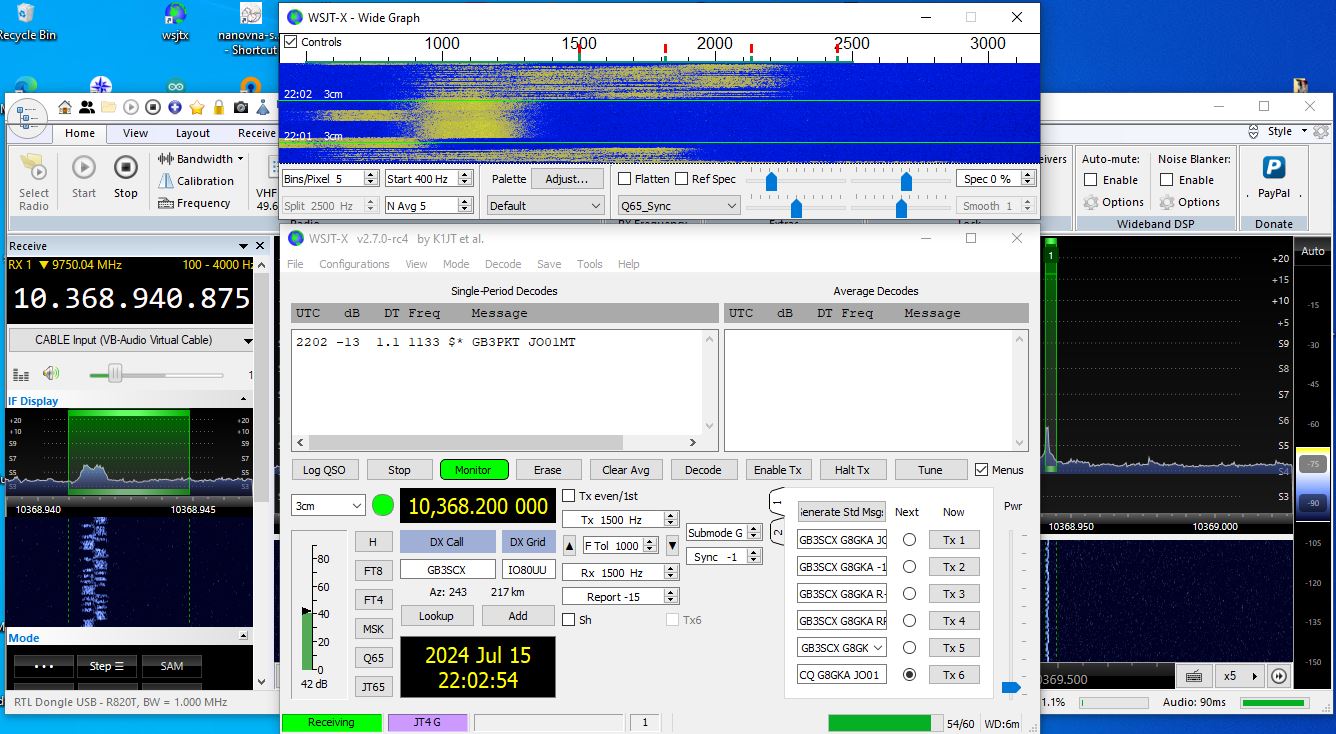
GB3PKT running JT4G
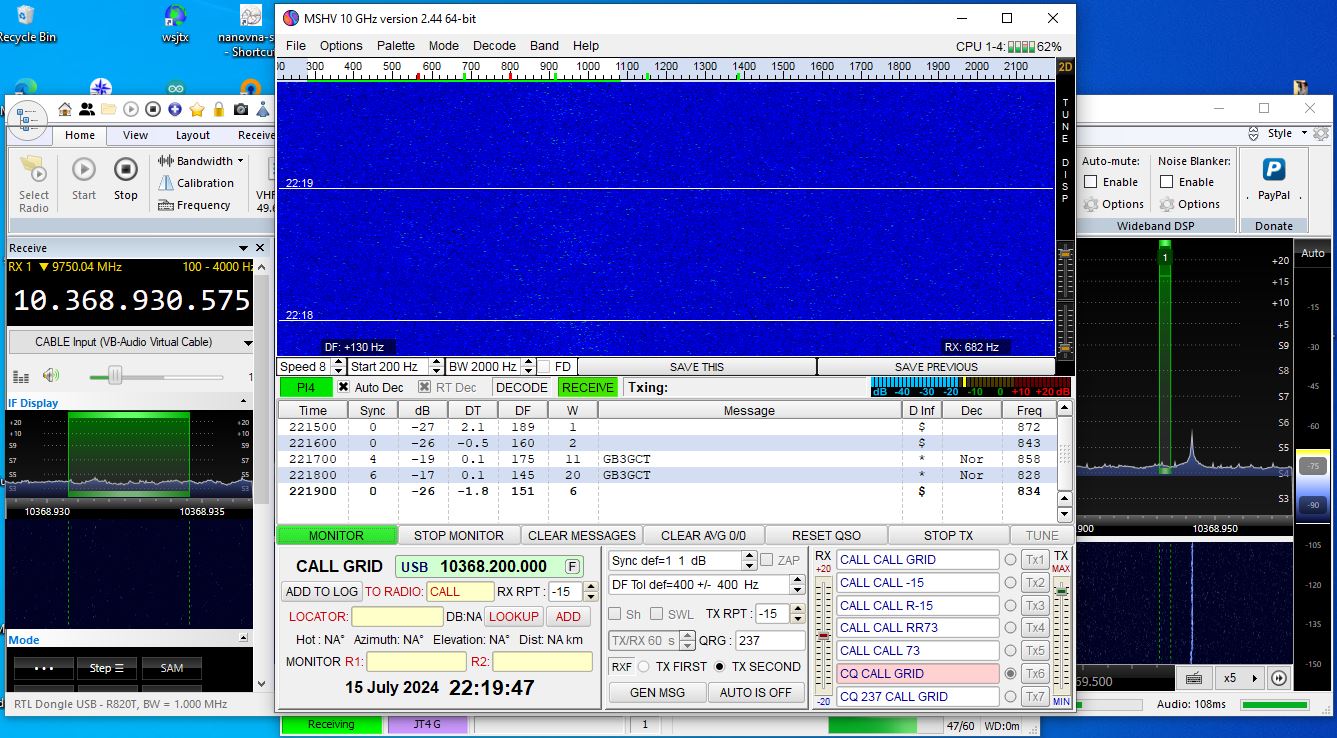
GB3GCT running PI4
Currently the SDR I’m using for these tests is not ref-locked and there’s no CAT connection between the laptop and FT-818. The next thing is to implement both which will help when looking for weak traces and measuring the effects of Doppler on a signal. My 10GHz operation is still very much WIP. 🙂
 G4HSK
G4HSK 