

Having spent many hours optimising my 10GHz EME setup I decided against trying to use the same gear for /P operation. I had great fun and learnt a lot building my QO-100 up and down converters so I decided I would try and build a second transverter (TVTR) for 10GHz.
I’d read many of Paul, W1GHZ articles where he described how he developed his series of simple low-cost transverters and what he learnt on his way. Encouraged by these articles I outlined my own transverter based around some of the modules I’d built for 2.4GHz / QO-100.
Here’s an outline of my proposed TVTR:

The receive side would use an LNA + modified LNB + my QO-100 down-converter. This would provide a 144MHz or 432MHz IF for the FT-818. This part was already tried, tested and in use on QO-100.
The transmit side was going to be the challenge as I wanted to adopt a modular building-block approach that used the popular “German Tin Boxes” that seem to be used to house many different projects in the world of microwave enthusiasts. It would use an ADF4351 + SynthShield, possibly an old G4DDK004 oscillator multiplier module then a 2556Mhz / 3456MHz multiplier LO module into a 10244MHz + 144MHz mixer / amplifier up-converter module.
The TVTR and LO boards that Paul can supply do not appear to fit any of the standard size tin boxes so I decided that I would try putting my KiCad skills to the test and try to do my own.
After several hours spent working with KiCad I had two PCB layouts that I was happy with. I uploaded a set of Gerber files to JLCPCB and waited for the boards to arrive. Full of confidence I decided to “Go For Gold” opting for the more expensive ENIG finish rather than standard HASL.
JLCPCB did their usual excellent service and the boards soon arrived. They looked excellent as you can see in the following photos:

New Boards and Shiny Tin Boxes
The LO board was assembled and ready for testing. The ADF4351 with its SynthShield providing the 3408MHz input to the LO board, multiplied by three and amplified should hopefully produce around +7 dBm output on 10224MHz (10224 + 144MHz IF = 10368MHz)
Having gained experience constructing pipe-cap filters for 2.4GHz the two needed for the LO board went together without any problems.

Test Fit
Applying volts didn’t cause any Magic Smoke to escape, the current drawn seemed okay but there was lots of RF output on the power meter and that was with a 50R load on the input of the board. It was “hooting” (oscillating) big time and that was without the bottom lid in place! I was aware of the challenges of boxing things up, especially at higher frequencies and I recalled a comment that Paul had made in one of of his articles. I need some RAM (Radiation Absorbent Material) was my first thought. Careful positioning of little pieces of absorber should fix it.
Fortunately I had a small 25mm x 35mm piece of this special and rather expensive material hidden in one of my “safe places”. It was put away probably over 30 + years ago when I started building a G3WDG 10GHz transverter.
I spent much too much time moving small pieces of RAM about in an attempt to stop the “hooting”. Adding some additional Vias was a challenge, trying to do that with wire through 0.8mm thick board is a challenge especially where there’s solder mask present. Extra decoupling also failed to resolve the problem. I went away and read about Microwave PCB Design and in particular guidelines on ground-stitching Vias.
This resulted in a Rev 2 board design and another set of files being uploaded to JLCPCB. With my confidence dented I decided not to go for the ENIG finish this time and just go standard HASL
Five new boards soon arrived, they clearly had lots more Vias compared to my previous boards! Probably so many to make those “in the know” i.e. those with good RF PCB design skills laugh, but my approach this time was “more is better”. 🙂
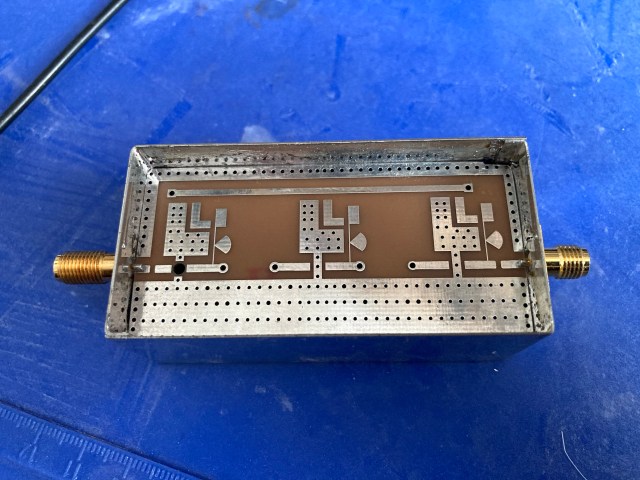
New Rev2 LO Board
I managed to salvage what I could from the first build. The MIMIC devices, enclosure and SMA sockets were reused. This also saved me some extra metal-bashing which is my least favourite part of any project.
With the new board assembled and soldered into the tin box it was ready for testing. Once again it didn’t produce any Magic Smoke. With just a 50R load on the input this time it did not produce any RF output! Connecting the ADF4351 in a powered off state also resulted in no indication of any hooting. Things were looking up.
With only the two pipe-cap filters to tune the adjustment for maximum output was quite simple. I tuned things first without the bottom lid in place and then with it fitted. The LO module appears to be stable with the lid on or off and without any RAM fitted. Checking the output using the test equipment available to me I could not detect any unwanted oscillations.
With the 3408MHz input from the ADF4351 the LO module produced +6dBm (measured on a HP432A + 18GHz sensor) which is ideal for the mixer input on the TX module.
Using the output of a modified LNB into my Rigol DSA815TG I took a very quick look at the output of the LO. More in depth checks and measurements are planned once the TX mixer board is built and working. For this quick test I did not have the LNB reference-locked to my 25MHz GPSDO source hence the marker not being at 10244.00MHz
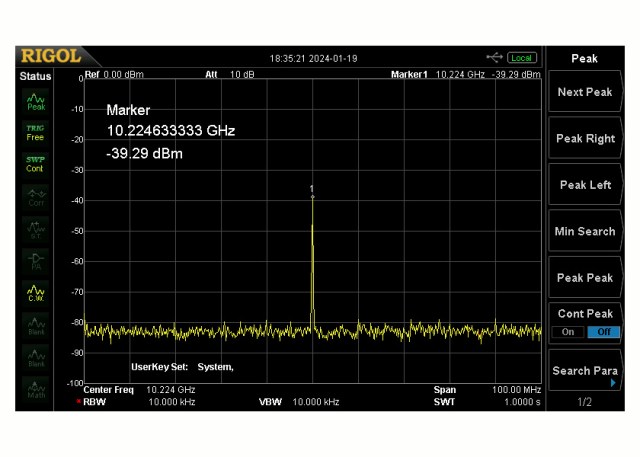
10224MHz LO Output
What’s Next:
- Experiment with an additional MIMIC amplifier btween ADF4351 and LO Board.
- Compare the 10224MHz output with the ADF4351 running at either 2556MHz or 3408MHz
- Investigate Ref Locking an old G4DDK004 Oscillator Multiplier board (2556MHz output) and then compare final 10224MHz output (spurs, phase noise etc) against the ADF4351 input at 2556MHz
Acknowledgements:
- Paul Wade, W1GHZ for sharing his ideas, experience and encouragement to inspire people to have a go and try the GHz bands.
 G4HSK
G4HSK 